Radiant Space Heating Systems
Whether you just want radiant space heating for a new addition or sunroom, remodeling a home, or heating an entire building, Heatizon Systems low-voltage and line voltage radiant space heating offers the comfort, safety, and reliability you’d expect from a luxury heating system.
Unlike conventional heating systems, radiant space heating products produce a clean, quiet, and uniform heat that transforms cold floors and furniture into radiant heat emitting objects. This eliminates air drafts and limits heat loss, creating an even, luxurious warmth from head to toe. Take off your shoes and relax with Heatizon radiant heating systems.
Safety For Your Family
Heatizon’s radiant space heating systems operate at low voltage — no hot surfaces, no exhaust gases, and nothing under high pressure. All systems include a self-diagnosing control unit that continuously monitors system operation and alerts to any fault condition. Not only do our systems incorporate gentle warmth throughout your floors, but only Heatizon has a built in safety computer that constantly monitors the operation of your radiant heating system insuring the safety of you and your loved ones.
Two great options for installing radiant space heating:
New/Remodel Retrofit
| HEATIZON SYSTEM COMPARISON | HEATIZON Low Voltage Electric Radiant System |
HYDRONIC Hot Water Radiant System |
|
| EFFICIENCY | |||
| Efficiency at 100% capacity | 100% | 65-85% | |
| Efficiency at 50% capacity | 100% | 35-65% | |
| 99% of energy is used for heating | Yes | No | |
| Proper sized capacity for “Off Peak” conditions | Yes | No | |
| Requires two energy sources | No | Yes | |
| MAINTENANCE | |||
| Moving parts, pumps, valves, etc. | No | Yes | |
| Easy to repair | Yes | No | |
| Routine maintenance and service required | No | Yes | |
| Simple and reliable controls | Yes | No | |
| COST SAVINGS | |||
| Expandable – – Easy and Economical | Yes | No | |
| Works with almost all floor coverings | Yes | No | |
| Easy and economical installation | Yes | No | |
| Extra square footage required to accommodate system ($100 to $300/square foot) |
No | Yes | |
| Exhaust and/or fresh air venting required | No | Yes | |
| Structural modifications and concrete required | No | Yes | |
| REMODELING | |||
| Retrofit into existing surfaces | Yes | No | |
| Simple modification for remodeling | Yes | No | |
| Effective in small or large areas | Yes | No | |
| HEALTH & SAFETY | |||
| Environmentally friendly | Yes | No | |
| Safe (low-voltage, no hot surfaces, no exhaust gases, nothing under high pressure) |
Yes | No | |
Worry Free Reliability
The entire Heatizon Systems product line is solid state, has no moving parts to wear out, and has nothing that requires routine maintenance. In addition, our quality heating elements are the longest lasting available and are backed by industry leading warranties. Completely eliminate winter heating maintenance with the most reliable radiant space heating system available.
All Heatizon space heating products are ETL listed by Intertek to UL and CSA standards — independently certified by an OSHA-recognized Nationally Recognized Testing Laboratory for the United States and Canada.
Efficiency
Heatizon’s radiant space heating systems radiate heat directly from the floor or wall surface toward room occupants and objects in the space — allowing comfortable temperatures at lower thermostat settings than forced-air systems. Because radiant heat is stored in the floor and surrounding thermal mass, warm temperatures are maintained efficiently between heating cycles, reducing energy consumption compared to convective systems that lose heat rapidly to air movement.
Computer-based operation
A radiant space heating system can’t claim to be safe, efficient, or reliable unless there is a way to monitor it 24/7. Heatizon Systems low voltage radiant heating products are self monitoring providing the safest products in the industry.
Space Heating for New / Remodel


If you’re looking for an efficient way to heat a sun-room, basement, or even your entire home or office, you’ve come to the right place. Heatizon Systems manufactures energy efficient space heating products that can be suited to work in any radiant heating application. Heatizon provides products to match your project, we offer the most versatile product line on the market today and unmatched customer and project support.
Select the right heating element.
For effective home space heating, you must select a radiant heating element that efficiently transfers heat, but is also safe to use. Heatizon Systems has tested and tried many types of elements, and found several winners.
WarmWallz electric radiant panels mount on walls or ceilings and heat spaces quickly and efficiently — available in multiple finishes, configurations, and wattages for residential and commercial applications. No floor preparation required.
Radiant Heating Joists or Retrofit
Installing a radiant space heating system can be done even when you have finished floors. While the majority of floor heating products are in floor radiant heat systems, they have to go in before the installation of the floor covering. Heatizon Systems was the first to develop a method with our versatile ZMesh product that can be installed underneath the floor in the joists that, when installed, effectively heats an area from below the floor of the room you wish to heat. Installing our ZMesh system in the joists of your floor is an easy and convenient method to an afterthought problem!
ZMesh RetroFitting
Installing a radiant heating systems is easy when you are remodeling or building a new house, but what if the floor is already installed, and you don’t want to tear everything up to get radiant heat? You’re definately not out of luck, because Heatizon Systems was the first to engineer a radiant floor heating joist system as well.
Other Related Applications
Be sure to learn more about our radiant floor heating systems and slab heating/heat loss applications for more specifics related to those types of systems.
Frequently Asked Questions
Floor & Space Heating
WarmWallz panels mount to a wall or ceiling using the included wall mount or ceiling bracket, compatible with all models. Installation does not require structural modification — the panel is mounted directly to the wall or ceiling surface and connected to the electrical supply per the model’s wattage and voltage requirements.
Outside of regular cleaning/dusting, yes. WarmWallz panels are solid-state with no moving parts, requiring no routine maintenance or servicing after installation.
WarmWallz panels can serve as either a primary heat source for a room or as supplemental heating alongside an existing system, depending on the panel wattage selected relative to the room’s heat loss. Heatizon offers WarmWallz panels in a range of sizes and power outputs to match different room sizes and heating requirements — see the size and wattage chart for available configurations.
WarmWallz panels include a wall mount or ceiling bracket compatible with all models. Optional accessories include a towel rail, available on select GS and CR wattages, and wall offset screws, available on all models except the U line. Additional accessories may be available for special installation conditions — consult a Heatizon distributor for availability.
The right WarmWallz model depends on three factors: mounting location (wall, ceiling, or both), desired finish (smooth, textured, decorative, or glass), and the heat output required for the space. WarmWallz Basic and U+ offer the most installation flexibility with both wall and ceiling mounting. WarmWallz U is ceiling-only with enhanced heat dispersion. WarmWallz CR is wall-only with a decorative finish. WarmWallz GS offers a glass surface for wall or ceiling installation. Contact a Heatizon distributor to select the right model and size for your specific space and heat loss requirements.
WarmWallz CR is a wall-mountable radiant heating panel with an elegant decorative finish and texture, designed to add radiant heating to a space while complementing the interior design. CR panels are wall mountable only.
WarmWallz GS is a radiant heating panel with a glass heating surface, suitable for both wall and ceiling mounting. The glass surface provides a clean, modern aesthetic alongside the panel’s radiant heating function, making it a common choice for bathrooms and visible living spaces where appearance matters alongside performance.
WarmWallz Basic has a smooth surface that is easy to clean and maintain, and can be mounted on either a wall or ceiling. WarmWallz U has a textured coating designed to improve heat dispersion across the panel surface, but is ceiling mountable only. The choice depends on whether wall mounting flexibility or improved heat dispersion is the priority for the installation.
Heatizon offers five WarmWallz model lines, each suited to different applications and finishes. WarmWallz (Basic) has a smooth, easy-to-clean surface and is wall or ceiling mountable. WarmWallz U has a textured coating for improved heat dispersion and is ceiling mountable only. WarmWallz U+ offers diverse sizes and coating options and is wall or ceiling mountable. WarmWallz CR provides an elegant decorative finish and texture and is wall mountable only. WarmWallz GS features a glass heating surface and is wall or ceiling mountable.
WarmWallz panels can be installed on walls or ceilings, depending on the model selected. Some models are wall or ceiling mountable, while others are designed for one mounting orientation only — see the model comparison for specific mounting compatibility. WarmWallz is suitable for residential and commercial spaces including bathrooms, offices, living spaces, and other interior rooms.
Yes. WarmWallz panels are ETL listed for sale and installation in the United States and Canada.
Radiant panel heating works by emitting infrared radiant energy that travels through the air largely unabsorbed until it strikes a solid object — a wall, piece of furniture, or floor. Approximately 85% of that radiant energy is absorbed by the object, raising its surface temperature directly. The warmed objects then radiate heat into the room and transfer some heat to the surrounding air by convection. This differs from forced-air heating, which heats air directly and relies on air circulation to warm the room.
WarmWallz is Heatizon’s line of premium electric radiant heating panels for walls and ceilings. The panels transfer heat primarily through radiant energy — approximately 85% of the radiant energy emitted is absorbed by surrounding objects (walls, furniture, floors), warming them directly, while the remaining heat transfers to the surrounding air by convection. This provides efficient, even heating without the air movement and temperature stratification of forced-air systems. WarmWallz is ETL listed for sale and installation in the United States and Canada.
Floorizwarm is available through Moreheat.com, Radiantshop.com and through Heatizon’s network of distributors.
Yes. Floorizwarm is highly customizable to the layout of the space — cable spacing can be adjusted to maximize heat output in areas where it’s needed most and minimize or eliminate heating in areas where it isn’t, such as under cabinetry or fixtures. This allows the kit to be configured precisely to the room’s actual layout rather than applying uniform heating across the entire floor area.
Yes. Floorizwarm’s Tuff Cable heating element is embedded in a mortar bed beneath the finished floor surface — the mortar acts as the heatsink, distributing heat evenly across the floor area above. This is the same installation method used for standard Tuff Cable floor heating installations.
Floorizwarm is compatible with tile, stone, slate, hardwood, laminate, engineered flooring, linoleum, vinyl, and carpet — installed wherever a mortar bed is used beneath the floor covering. It is also suitable for shower floors and other wet area applications.
Floorizwarm systems are designed to produce 7.5 to 15 watts per square foot. The lower end of this range is typically specified for comfort floor warming in well-insulated spaces, while the higher end is used where Floorizwarm needs to serve as a more significant heat source for the room — such as a small bathroom or laundry room with greater heat loss. Heatizon configures the wattage for each kit based on the specific room and application.
Floorizwarm carries a 25-year manufacturer warranty — the same warranty length as Tuff Cable, reflecting the fact that Floorizwarm uses the identical Tuff Cable heating element at its core.
Floorizwarm and standard Tuff Cable floor heating use the identical heating element — the difference is packaging and scale. Floorizwarm is a complete, pre-sized kit specifically configured for smaller areas, sold as a single package at a lower price point than ordering Tuff Cable separately for a custom large-area installation. For floor areas larger than a typical kitchen, bathroom, or entryway, a custom-designed Tuff Cable system is the more cost-effective option.
Floorizwarm is Heatizon’s complete, low-voltage radiant floor heating kit designed specifically for smaller and wet areas — kitchens, bathrooms, laundry rooms, entryways, and showers. It uses Tuff Cable, the same low-voltage coated copper heating element used across Heatizon’s larger snow melting and floor heating systems, embedded in a mortar bed beneath the finished floor. Floorizwarm is sold as a complete package — everything needed for the specified area is included.
Cozy Heat carries a 10-year manufacturer’s warranty across both the MI fixed-length and self-regulating variants — backed by the same mineral-insulated fiberglass construction used in Hott-Wire, which provides exceptional resistance to moisture, mechanical damage, and temperature extremes over the life of the installation.
Yes. The MI Cozy Heat cable — at 11.5–20 watts per lineal foot — can provide sufficient heat output for total space heating in residential and commercial buildings, including cabins, homes, basements, sunrooms, commercial buildings, and industrial facilities. System design targets 5–15 watts per square foot of heated area depending on the building’s heat loss characteristics, insulation values, and climate. The Cozy Heat system is designed and specified by Heatizon’s team to meet each project’s heat loss requirements — not sized to a generic formula.
Cozy Heat systems can be controlled by a programmable thermostat for individual zone control — specifying the temperature and schedule for each heated area independently. For larger installations with multiple heating circuits, a relay or contactor panel allows a single thermostat or control device to activate multiple zones simultaneously. Zone-designed systems provide comfort and energy savings by heating specific areas only when needed.
Cozy Heat operates at line voltage — 120V, 208V, 240V, or 277V (480V/600V for MI) — supplied directly from the building’s electrical panel without a step-down transformer. This makes it well suited to commercial and industrial floor and slab heating projects where line-voltage supply is standard and transformer-based low-voltage systems are impractical for large areas.
Yes for floor and space heating — the cable must be embedded in a cementitious material such as mortar, standard concrete, or lightweight concrete. The cementitious heatsink is essential for even heat distribution across the floor surface above; without it, heat concentrates at the cable rather than spreading across the floor. For slab heating and heat loss prevention, the cable is adhered directly to the underside of the concrete slab — the slab itself acts as the thermal mass, and no separate heatsink embed is required.
Yes. The self-regulating variant can be used for slab heating applications — adhered to the underside of the concrete slab using aluminum tape and fasteners, as with the MI variant. The SR variant’s self-regulating characteristics mean it will reduce output as the slab reaches temperature, providing built-in energy efficiency without requiring a separate thermostat to manage overheating. For higher heat loss requirements where maximum output is needed consistently, the MI variant is the recommended choice.
Choose the self-regulating Cozy Heat cable for smaller or irregularly shaped floor areas, retrofit projects where the exact cable layout is finalized on site, and applications in milder climates or well-insulated buildings where the lower maximum output of a self-regulating cable is sufficient. The SR variant produces 5,9, or 12 watts per lineal foot and adjusts its output automatically based on surrounding temperature — it cannot overheat and is tolerant of irregular spacing during installation.
Cold leads are the non-heating sections of cable that connect the heating element to the electrical panel. Standard MI cables require cold leads to be spliced on-site — adding labor time and introducing a potential failure point at the splice. Cozy Heat’s MI cable ships with cold leads already connected at both ends from the factory. The installer routes the cold leads from the heating zone to the panel and terminates them — no specialized splicing tools or additional field connections required.
For slab heating and heat loss prevention, the MI Cozy Heat cable is adhered to the underside of a concrete slab using aluminum tape and fasteners — not embedded in the slab itself. This configuration allows the cable to heat the slab from below, preventing heat loss through the concrete and maintaining the temperature of the space above. This installation method is used when access to the underside of an existing slab is available and embedding in a new pour is not feasible or required.
For floor and space heating, the MI Cozy Heat cable is embedded in a cementitious material — mortar, standard concrete, or lightweight concrete — beneath the finished floor surface. The cable is laid at the spacing specified in the system design, and the cementitious layer is applied over the top before the floor covering is installed. The heatsink provided by the cementitious embed distributes heat evenly across the floor surface above.
Choose the MI fixed-length Cozy Heat cable for large commercial and industrial floor heating projects, slab heating applications, and any installation where maximum watt output and long-term durability are the priority. The MI variant produces 11.5–20 watts per lineal foot — the higher end of the range needed for total space heating and demanding heat loss prevention applications. Because it is a fixed-length product, the cable length must be specified and ordered based on the system design before installation begins.
Yes. Cozy Heat is ETL listed — the same listing that covers Heatizon’s Hott-Wire cable, reflecting their identical cable construction. ETL listing is issued by Intertek, an OSHA-recognized Nationally Recognized Testing Laboratory carrying equal legal standing to UL and CSA listings in the United States.
Cozy Heat serves two distinct applications, each with a different installation method. The first is floor and space heating — where the cable is embedded in a cementitious material such as mortar, concrete, or lightweight concrete beneath the floor covering, warming the floor surface and the room above. The second is slab heating and heat loss prevention — where the cable is adhered to the underside of an existing concrete slab using aluminum tape and fasteners, preventing heat loss through the slab and maintaining the temperature of the space above. The installation method, cable spacing, and watt output target differ significantly between the two applications.
Cozy Heat and Hott-Wire share the same fundamental cable construction — both are mineral-insulated line-voltage cables with fiberglass insulation, a copper outer tube, HDPE jacket, and factory pre-connected cold leads on the MI variant. The difference is application: Hott-Wire is designed and rated for outdoor snow melting in concrete, asphalt, and pavers. Cozy Heat is designed for interior floor warming, space heating, and slab heating applications. Both are ETL listed and available in MI fixed-length and self-regulating cut-to-length variants.
Cozy Heat is Heatizon’s line-voltage electric radiant heating cable for interior floor warming, space heating, and slab heating — available in two configurations. The MI (mineral-insulated) fixed-length variant uses a central copper conductor surrounded by fiberglass insulation compressed inside a copper outer tube with an HDPE jacket, factory-terminated with pre-connected cold leads at both ends. The self-regulating cut-to-length variant automatically adjusts its heat output based on ambient temperature and is cut to length on site. Both variants are ETL listed and operate at line voltage — no step-down transformer required.
Yes — unlike ZMesh, Tuff Cable must always be embedded in a heatsink material. For floor heating, this is typically a mortar bed, concrete slab, or self-leveling cementitious compound. The heatsink stores and distributes the heat from the cable evenly across the floor surface. This requirement adds some installation complexity compared to mesh-based systems, but results in excellent, even heat distribution and long cable life due to the protection the embed provides.
Yes. Tuff Cable floor systems can be designed for both supplemental floor warming — where the primary heat source is a furnace or boiler — and total space heating, where the radiant floor system provides all the heat for the space. Total space heating applications require higher wattage and closer run spacing than floor warming. Heatizon’s design team determines the correct configuration based on room dimensions, insulation levels, heat loss calculations (provided by the project’s engineer), and climate data.
Tuff Cable is compatible with almost all floor coverings where a heatsink material is present in the floor assembly — including hardwood, carpet, tile, laminate, engineered wood, linoleum, and vinyl. The heatsink is typically concrete, a mortar bed, or a self-leveling compound into which the Tuff Cable is embedded before the floor covering is installed. Unlike ZMesh, Tuff Cable requires this heatsink layer — it cannot be installed directly under flooring without an embed.
Yes. Tuff Cable is listed by Intertek (ETL) — an OSHA-recognized Nationally Recognized Testing Laboratory — to UL and CSA standards for snow and ice melting on surfaces and roofs, and for interior floor heating applications. Together with ZMesh, Tuff Cable is one of only two products in the world authorized under UL Standard 1588 for snow and ice melting installed under roofing materials. All Heatizon systems are designed to ASHRAE standards for heating load calculation and energy efficiency.
Tuff Cable and ZMesh are both Heatizon low-voltage heating elements and both are ETL listed under UL Standard 1588 for under-roof snow melting — but they are designed for different installation methods. Tuff Cable is a round copper cable that must always be embedded in a heatsink material (concrete, asphalt, mortar, Invizimelt panel). ZMesh is a flat bronze mesh that lays directly beneath flooring or roofing without any embed. Tuff Cable is the right choice where a heatsink is present or required — driveways, metal roofs, floor overlays. ZMesh is the right choice where no embed is possible or desired — under non-metal shingles, hardwood floors, and carpet.
Tuff Cable carries an industry-leading 25-year manufacturer’s warranty — the longest available for any electric radiant heating cable in its category. The warranty reflects the cable’s construction: 10-gauge coated copper heating cable that gets embedded in a protective heatsink, with footage marks for verifiable installation, and a low-voltage design that reduces electrical stress on the insulation over time. Heatizon has documented installations from decades ago that remain fully operational.
Tuff Cable is a low-voltage system powered by a step-down transformer that reduces the supply voltage — typically 120V, 208V, 240V, or 277V AC — to 65 volts or less at the cable. This low operating voltage is one of Tuff Cable’s key safety advantages over line-voltage systems, and it also allows the cable to be cut and spliced in the field, and to be installed in surfaces where line-voltage systems are not permitted or practical.
Tuff Cable is a low-voltage electric radiant heating cable made from a specially-engineered copper heating wire (approximately 10-gauge), manufactured by Heatizon Systems. It is chemical and gasoline resistant, comes with footage marks printed along the cable for easy layout verification, and is designed to always be embedded in a heatsink material — such as concrete, asphalt, mortar, stone, pavers, or Heatizon’s Invizimelt Panel. Tuff Cable is a cut-to-length product, giving installers precise control over system sizing without material waste.
ZMesh is a cut-to-length product, unlike most UL-listed radiant heating cables which are fixed-length. This gives installers flexibility to size each run precisely to the space — eliminating the waste and design constraints of fixed-length systems. ZMesh is available in rolls from 50 to 400 feet and can be cut on site to the exact length required by the project layout.
Yes. ZMesh is one of the only radiant heating elements on the market that can be repaired in the field if cut or damaged. Repair requires a customized copper splice plate and solder — a straightforward process compared to the full element replacement required by most competing fixed-length heating cables. This repairability is a meaningful long-term advantage, particularly for installations that may be subject to renovation or remodeling work years after the original installation.
Yes — provided the nail, screw, or staple does not make contact with any other electrically conductive material. ZMesh can be nailed and stapled through freely during roofing and flooring installation, which is one of its key practical advantages over conventional heating cables. This eliminates the need to plan fastener locations around the heating element and allows standard roofing and flooring installation techniques to proceed unmodified.
Yes. ZMesh can be retrofitted between floor joists from an unfinished basement or crawlspace below, without disturbing the finished floor above. This makes it one of the only radiant heating elements that can be added to an existing home without any flooring removal — a significant advantage for renovation projects where disruption and cost need to be minimized.
Yes. ZMesh is well suited to hardwood floor heating. The 12-inch width is the standard recommendation for hardwood applications. Before installation, allow the hardwood to acclimate to the room’s humidity level for several weeks to minimize dimensional changes after heating begins. After laying and connecting ZMesh, test and then run the system for before nailing or stapling the hardwood to the subfloor — this allows the wood to adjust to its heated operating temperature. As with all radiant floor heating under hardwood, confirm with the flooring manufacturer that surface temperatures will not exceed 85°F.
No. Unlike most radiant heating cables that must be embedded in a mortar or self-leveling compound to transfer heat, ZMesh is installed directly beneath the floor covering without any mortar bed or heatsink embedment. Because ZMesh is only 1/16 inch thick, it adds virtually no height to the floor assembly — eliminating the cost of a cementitious mud bed, the structural upgrades needed to support its weight, and the installation complexity it introduces. This makes ZMesh one of the most practical radiant floor heating solutions for both new construction and retrofit projects.
ZMesh carries an industry-leading 25-year manufacturer’s warranty. The long warranty is backed by the product’s construction: because ZMesh is installed under roofing or flooring rather than exposed to the elements, it is protected from UV damage, physical impact, and weathering. Heatizon’s distributors have documented ZMesh installations from decades ago that remain fully operational and visually unchanged. In most installations, ZMesh will outlast the roofing or flooring material installed above it.
The width choice affects heat output, not coverage area. The 9-inch mesh allows more runs to be placed in a given space, resulting in higher watts per square foot — up to 13 watts per square foot — making it the recommended choice for roof deicing where aggressive snow and ice melting is needed. The 12-inch mesh produces a lower watt density, which is better suited for radiant floor heating where even, gentle warmth is the goal. Heatizon’s design team specifies the appropriate width for each project based on application and local climate.
ZMesh serves two distinct applications: under-shingle roof deicing and ice dam prevention, and radiant floor and space heating. For roof applications, ZMesh is installed beneath non-conductive shingles, membranes, and wood decking to melt snow and ice from eaves and valleys. For floor applications, ZMesh is installed beneath virtually any non-conductive floor covering — including hardwood, tile, stone, carpet, engineered wood, linoleum, and vinyl — to provide even, comfortable radiant warmth. Both applications use the same physical element; the installation method and wattage configuration differ by use case.
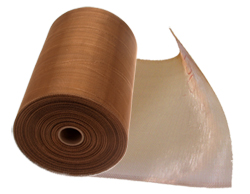
ZMesh is a woven bright bronze metal mesh heating element manufactured by Heatizon Systems. It resembles screen door material in appearance and is approximately 1/16 inch thick, available in 9-inch and 12-inch widths and in lengths from 50 to 400 feet. The bronze construction is highly durable, fully recyclable, and designed to outlast the roofing or flooring installed above it. ZMesh has been in continuous production and use since 1979.
ZMesh comes with an industry leading, 25-year manufacturer’s warranty.
Since 1979, Tuff Cable systems have been sold worldwide and are still in operation, worry free.
Tuff Cable comes with an industry leading, 25-year manufacturer’s warranty.
Tuff Cable is ETL Listed for snow and ice melting on surfaces and roofs and for interior floor heating applications.
