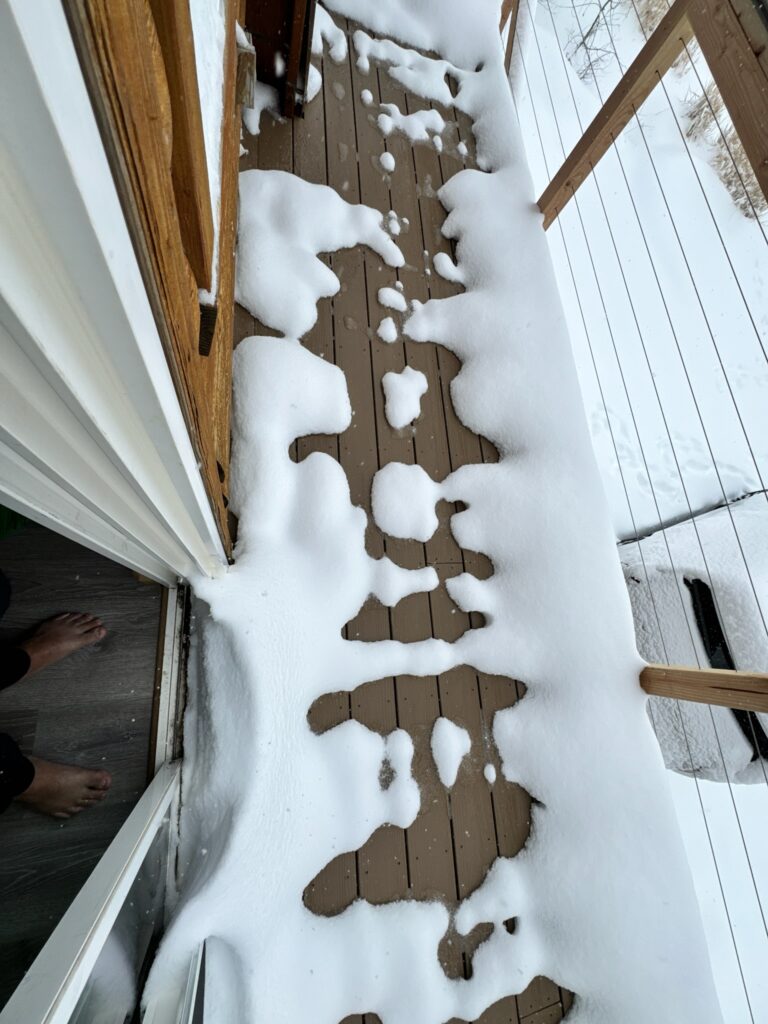
Heatizon’s patented deck pan heating system keeps wood-framed decks snow and ice free — invisible in the finished surface, automatic activation, 120V to 277V. Built on Hott-Wire MI line-voltage cable.
Heatizon has engineered a patented deck pan heating system specifically for wood-framed decks with 12-inch or 16-inch joist spacing — delivering radiant heat upward through the deck surface to melt snow and ice before it accumulates. Insulated aluminum heating pans sit directly on the joists beneath the deck face, Hott-Wire mineral-insulated line-voltage cable routes through the pan channels, and heavy-duty aluminum tape covers the cable to distribute heat evenly across the full pan surface. The result is a completely invisible snow melting system — the finished deck looks and performs exactly as it would without any heating system installed. Every deck pan system is custom-configured for the project and activates automatically.
How the deck pan system works
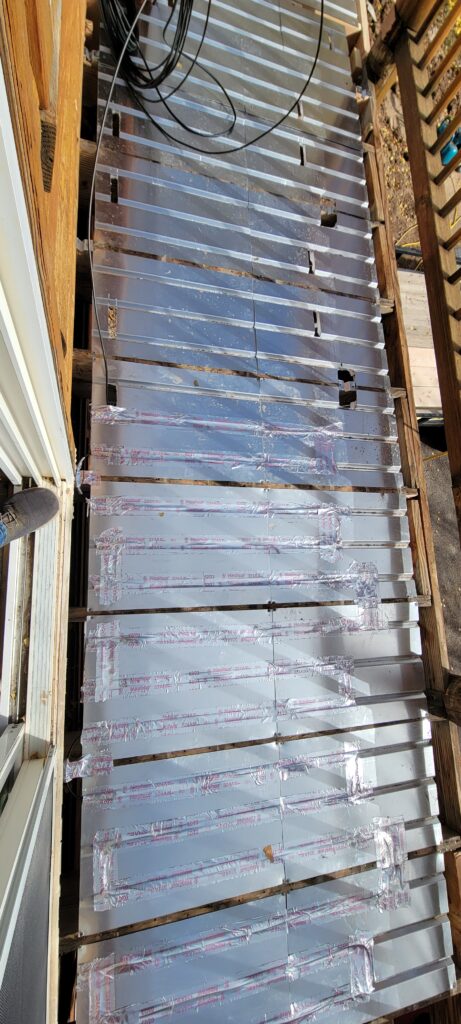
The deck pan heating system is installed between the joists and the deck surface. Insulated aluminum heating pans are placed on the joists, spanning the gaps between them, with all pan channels aligned in the same direction. Where the Hott-Wire cable crosses over a joist, a small aluminum joist plate sits between the cable and the joist — protecting the wood from direct contact with the line-voltage cable and maintaining a safe, code-compliant installation.
Once the pans are positioned and joist plates are in place, Hott-Wire MI cable is routed through the pan channels following the project layout. Heavy-duty aluminum tape is then applied over the cable and across the pan surface. Aluminum’s high thermal conductivity spreads heat rapidly and evenly from the cable across the entire pan face, directing it upward through the deck surface above — the same heat transfer principle used in Heatizon’s Invizimelt roof deicing panel system. The deck face is then installed directly on top of the pans. Screws and nails can pass through the aluminum pan material or between adjacent pans to secure the decking to the joists below — no routing around fastener locations required.
The system supports 120V, 208V, 240V, and 277V supply voltages directly — no step-down transformer required — and activates automatically via a snow and ice detection sensor when conditions require it.
New construction and retrofit
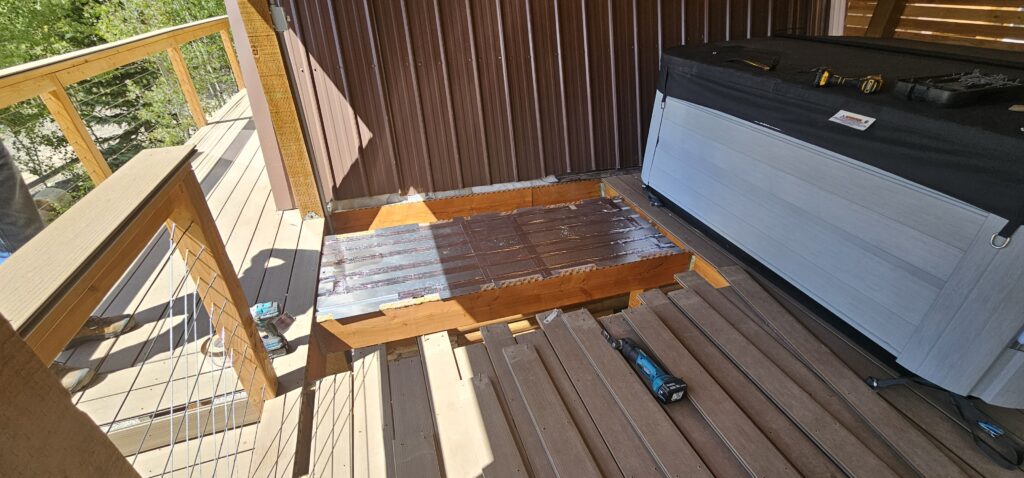
For new deck construction, the system is installed after all joists are in place and before the deck surface is added. For existing decks, the deck surface is removed to expose the joists, the pan system is installed, and the deck surface is reinstalled over the top. Both 12-inch and 16-inch joist spacing are compatible — no minimum clearance is required.
What’s included
Every Heatizon deck pan heating system ships as a complete, custom-configured package:
- Hott-Wire MI heating cable — mineral-insulated, fixed-length, factory pre-connected cold leads, no field splicing required
- Insulated aluminum heating pans — sized and configured for the project’s joist spacing and deck dimensions
- Aluminum joist plates — protect joists at every cable crossing point
- Heavy-duty aluminum tape — for heat distribution across the full pan surface
- Relay panel — allows a single automatic activator to control multiple heating circuits
- Automatic snow and ice detection activator — system activates when needed, switches off when conditions clear
Each system is individually designed for the project. A complete set of electrical specifications accompanies every package to guide the licensed electrician connecting the system to the supply.
Technical specifications
| Primary heating element | Hott-Wire MI line-voltage cable — fiberglass insulation, factory pre-connected cold leads |
| Compatible joist spacing | 12-inch or 16-inch on center |
| Supply voltage | 120V, 208V, 240V, or 277V |
| Heat transfer method | Aluminum tape over cable in pan channels — distributes heat upward through deck surface |
| Compatible deck surfaces | Wood, Composite, or other decking materials |
| Activation | Automatic snow and ice detection sensor; relay panel for multi-circuit control |
| Included | Cable, pans, joist plates, aluminum tape, relay panel, activator, electrical specifications |
| Manufacturing | United States of America |
Secondary options for other deck constructions
The deck pan system is Heatizon’s primary and most complete deck deicing solution for wood-framed joist construction. For other deck constructions, two secondary options are available.
For decks with a concrete or mortar substrate where cable can be embedded, please see our traditional snow melting systems.
For systems where a solid sub-deck would needed to be used beneath traditional decking materials, Tuff Cable with Invizimelt, or ZMesh could be used. Contact a Heatizon distributor to confirm the right approach for a specific deck construction.
For rooftop terraces and elevated areas using pedestal-supported pavers, see Heatizon’s pedestal paver snow melting system — a separate system designed specifically for that application.”
Why specify the Heatizon deck pan heating system
The most common conclusion reached by builders, architects, and homeowners searching for wood deck snow melting is that no good solution exists. Standard heat trace cables require a conductive heatsink to transfer heat to the surface above — wood and composite decking don’t conduct heat efficiently enough to make surface cable systems work. Hydronic systems require boilers, pumps, pipes, and manifolds — impractical for most residential and light commercial deck applications. Portable heating mats are a temporary workaround, not a permanent solution.
Heatizon’s deck pan heating system is the engineered answer to this gap. The insulated aluminum pans provide the heatsink that wood decking cannot — heat from the Hott-Wire MI cable transfers through the aluminum pan and tape into the deck surface above efficiently, regardless of the decking material’s own thermal conductivity. The system is patented, complete, and custom-designed for each project. It is the only purpose-built, permanently installed electric deck pan heating system for wood-framed joist construction available from a listed manufacturer in the United States.
Engineering built into every component
Three specific design choices in the deck pan system reflect engineering decisions, not cost-saving compromises.
- Aluminum pans, not plastic or composite. Aluminum’s high thermal conductivity is what makes the system work — it spreads heat rapidly and evenly from the Hott-Wire cable across the entire pan surface and into the deck above. A lower-conductivity heatsink material would create hot spots at the cable and cold spots between runs, producing uneven melting and reduced efficiency.
- Aluminum joist plates at every cable crossing. Where Hott-Wire line-voltage cable crosses over a joist, a small aluminum joist plate sits between the cable and the wood, protecting the joist from direct contact with a line-voltage heating element. This is a safety and code-compliance detail built into the standard system — not an optional add-on.
- Hott-Wire MI cable, not self-regulating cable. The fixed-length MI variant delivers consistent, predictable heat output across its full length — essential for a system designed to meet a specific watt-per-square-foot target across the deck surface. Self-regulating cable varies in output by temperature; the MI variant delivers the design load regardless of conditions.
A complete system from a listed manufacturer
Every Heatizon deck pan heating system ships as a complete, ETL-listed assembly — pans, Hott-Wire MI cable, aluminum joist plates, aluminum tape, relay panel, and automatic activator. Heatizon does not sell heating cable separately for installation in third-party pan systems, and does not endorse unlisted pan systems from other manufacturers. The system is listed and patented as a complete assembly because that is the only configuration in which Heatizon can guarantee performance and safety.
This matters for permitted construction. A heating system installed beneath a deck surface is an embedded electrical system subject to local building codes and electrical inspection. Specifying a complete system from a listed manufacturer — rather than assembling components from multiple sources — gives the inspector a single listed assembly to verify, simplifies the permitting process, and protects the building owner with a manufacturer warranty on the full system rather than individual components.
Complete the system
For decks adjacent to gutters or downspouts, pair the deck pan system with GutterMelt to keep the full drainage path clear — meltwater from the heated deck surface needs a clear path through gutters and downspouts to the ground.
For decks over a heated living space or roof, a roof deicing system installed on the roof below — ZMesh for non-metal roofing or Tuff Cable in Invizimelt for metal roofing — prevents meltwater from the deck from refreezing at the roof edge below.
Built by Heatizon — US manufacturer since 1979
Heatizon Systems has designed and manufactured electric radiant heating products in the United States since 1979. The deck pan heating system is built on the same Hott-Wire MI cable used across Heatizon’s snow melting and surface heating product line — the same cable that powers the pedestal paver snow melting system and is available separately for concrete, asphalt, and paver snow melting applications. For projects requiring both deck heating and adjacent roof or gutter protection, Heatizon can design and supply the complete system — deck pans, GutterMelt for drainage, and roof deicing if required — from a single listed source.
Frequently Asked Questions
Deck Snow Melting Systems
Small aluminum joist plates are included to protect the joists where the Hott-Wire cable crosses over them during installation. Because Hott-Wire is a line-voltage cable, direct contact with the wood joist at crossing points needs to be avoided — the joist plates sit between the cable and the joist surface at those points, protecting the wood and maintaining a safe installation. They are part of the complete system package.
Decks over a heated living space or roof present a secondary concern — meltwater from the deck can run down onto the roof beneath and refreeze, forming ice dams at the roof edge. Installing a roof deicing system on the roof below the deck — ZMesh for non-metal roofing or Tuff Cable in Invizimelt for metal roofing — ensures meltwater has a complete path off the building without backing up under the roof edge.
For decks adjacent to gutters or downspouts, pairing the deck pan system with GutterMelt keeps the full drainage path clear — meltwater from the heated deck needs to flow freely through gutters and downspouts to the ground. GutterMelt is recommended wherever deck meltwater drains into a gutter system.
Yes, There are a few secondary options are available for specific deck constructions. For decks with a concrete or mortar substrate — where embedding cable is feasible — Tuff Cable can be embedded directly in the substrate for even heat distribution. For decks with non-conductive wood or composite decking on traditional framing where no heatsink or pan system can be fitted, ZMesh or Invizimelt can be laid on a solid sub-deck beneath the decking. Both are secondary solutions; the deck pan system with Hott-Wire is Heatizon’s recommended and most complete deck deicing approach for wood-framed joist construction.
Yes. The deck pan system — pans, Hott-Wire cable, relay panel, and activator — contains no moving parts. No moving parts means no wear components, no scheduled mechanical maintenance, and no service requirements beyond verifying activation at the start of each winter season.
The system activates automatically via a snow and ice detection sensor that triggers heating when temperature drops below threshold and moisture is present — no manual switching required. A relay panel allows a single activation device to control multiple heating circuits across larger deck surfaces simultaneously.
The deck pan heating system supports 120V, 208V, 240V, and 277V supply voltages — compatible with most residential and commercial electrical configurations without requiring a transformer. Voltage is specified at the time of system design based on the project’s electrical supply.
Heavy-duty aluminum tape is applied over the Hott-Wire cable after it is routed into the pan channels. Aluminum’s high thermal conductivity spreads heat rapidly and evenly across the full pan surface, directing it upward through the deck surface above. Without the tape, heat would concentrate at the cable rather than distributing across the pan, reducing melting efficiency significantly. The aluminum tape is what makes the pan system an effective heatsink in addition to a simple cable holder.
The deck pan system uses Hott-Wire MI (mineral-insulated) fixed-length cable — a central copper conductor surrounded by fiberglass insulation inside a copper outer tube and HDPE jacket, with cold leads factory pre-connected at both ends. The MI variant’s construction withstands the mechanical loads of deck installation and delivers consistent, reliable heat output over the life of the installation. Factory pre-connected cold leads eliminate field splicing during installation.
Every Heatizon deck pan heating system includes Hott-Wire heating cable, insulated aluminum heating pans, joist plates, heavy-duty aluminum tape, a relay panel, and an automatic snow and ice detection activator. Each system is custom-configured to the project’s dimensions, joist spacing, voltage, and decking material.
Aluminum insulated heating pans are placed over two joist gaps (24″ or 32″), notches are made to install joist protection plates where the heating cable crosses any wood. Next, Hott-Wire MI line-voltage cable is then routed through the pan channels and covered with heavy-duty aluminum tape, which spreads heat rapidly and evenly across the full pan surface and directs it upward into the deck surface above. The deck face is installed on top — screws or nails can pass through the aluminum pan or between adjacent pans to secure the decking to the joists below.
Yes. For new deck construction, the system is installed after all joists are in place and before the deck surface is added — the pans are positioned on the joists, Hott-Wire is routed through the channels, and the deck face is then installed over the top. For existing decks, the deck surface must be removed to expose the joists, the pan system installed, and the deck surface reinstalled. Both 12-inch and 16-inch joist spacing are compatible.
The deck pan heating system is designed for wood-framed decks with joists spaced either 12 inches or 16 inches on center. The insulated aluminum pans are engineered to sit on the joists and span the gap between them, providing a continuous heated surface beneath the deck face.
Heatizon’s primary deck deicing solution is the deck pan heating system — a patented, complete assembly using insulated aluminum heating pans and Hott-Wire mineral-insulated line-voltage cable, engineered for wood-framed decks with standard 12-inch or 16-inch joist spacing. The pans sit on top of the joists beneath the deck surface, Hott-Wire cable is routed through the pan channels and taped in place, and the deck face is installed directly over the pans. The system is invisible in the finished deck, activates automatically, and is custom-configured for each project. For other deck constructions where the pan system is not applicable, Heatizon also offers secondary options using ZMesh or Tuff Cable — contact a distributor to confirm the right approach.