MI fiberglass construction with factory pre-connected cold leads — and a self-regulating variant. 208V, 240V, or 277V direct. No transformer. ETL listed. Hot-pour asphalt rated. 10-year warranty.

Hott-Wire is Heatizon’s line-voltage electric heating cable for snow melting and radiant heating — available in two variants. The mineral-insulated (MI) fixed-length variant uses a central copper conductor inside fiberglass insulation compressed within a copper outer tube and HDPE jacket, with cold leads factory pre-connected at both ends. The self-regulating cut-to-length variant automatically adjusts heat output based on surrounding temperature and is sized on site. Both variants operate at 208V, 240V, or 277V (MI version can accept 480V/600V) directly from the supply panel — no step-down transformer required — and both are rated for installation in hot-pour asphalt, new concrete, pavers, and retrofit saw-cut applications.
Mineral-Insulated (MI) Fixed-Length Cable
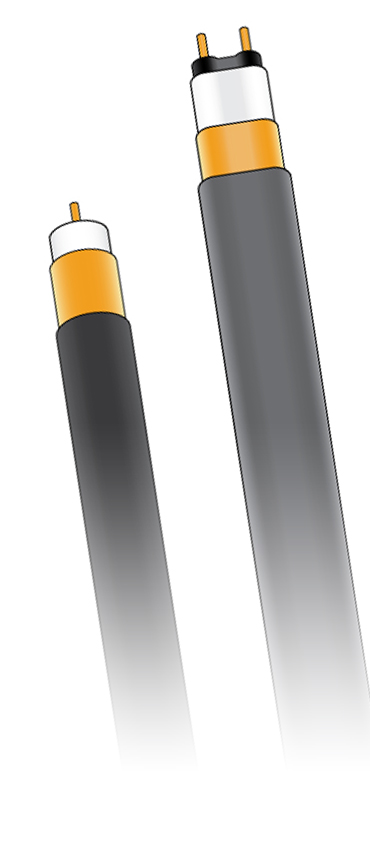
The MI Hott-Wire cable draws on a cable construction technology first patented in 1896 — the same fundamental design used in nuclear reactors, military equipment, fire alarm systems, and emergency infrastructure worldwide because of its extraordinary resistance to heat, moisture, and mechanical damage. Heatizon’s version uses fiberglass as the mineral insulation rather than the magnesium oxide (MgO) used in most MI cables. MgO is hygroscopic — it absorbs moisture over time, degrading insulation and eventually causing cable failure. Fiberglass is inert and does not absorb moisture, making Hott-Wire measurably more resistant to the humidity and freeze-thaw cycles of outdoor snow melting applications.
Cold leads — the non-heating sections connecting the cable to the electrical panel — are factory pre-connected on the MI variant. Standard MI cables require cold leads to be spliced on site, adding labor time and introducing a potential failure point at the splice. With Hott-Wire, the installer routes the cold leads from the heating zone to the panel and terminates them — no specialized splicing tools required.
The MI variant is a fixed-length product — cable length is specified and ordered based on the system design before installation begins. It is the right choice for large commercial and industrial surfaces, severe northern climates, high snow load requirements, and any project where maximum watt output and long-term durability are the priority.
Applications
Hott-Wire is used for snow melting in new-pour concrete, hot-pour asphalt, sand and stone dust beds under pavers, and retrofit into existing concrete or asphalt via saw-cut channels. Its MI construction is specifically rated for hot-pour asphalt installation — the copper outer tube and fiberglass insulation withstand the temperatures and chemical composition of freshly laid asphalt — a capability not available in most competing line-voltage heating cables.
Suitable installations include residential and commercial driveways, walkways, entry plazas, parking areas, loading docks, ramps, exterior stairs, and helipads. For large commercial surfaces where multiple circuits are needed, Hott-Wire connects to a relay or contactor panel that allows a single automatic snow and ice detection sensor to control all circuits simultaneously.
For under-roof deicing and smaller residential or commercial snow melting projects, Heatizon’s Tuff Cable low-voltage system is the recommended alternative — it operates at 65V via a step-down transformer and carries a UL 1588 listing for under-roof applications that Hott-Wire does not hold.
Self-Regulating Cut-To-Length Cable
The self-regulating Hott-Wire variant automatically adjusts its heat output based on ambient temperature — producing more heat when conditions are cold and less when they are warmer. This means the cable cannot overheat and is tolerant of overlapping or bundling during installation, making it more forgiving than the fixed-output MI variant in complex or irregular layouts. It is cut to length on site — no pre-ordering to exact specifications required.
The self-regulating variant is suited to smaller surface areas, retrofit projects where the installation layout is finalised on site, and milder climates where the lower maximum output of a self-regulating cable is sufficient. For maximum watt density and long-term performance in demanding conditions, the MI variant is the recommended choice.
Technical Specifications
| Voltage type | Line voltage — 208V, 240V, 277V, 480V, or 600V AC direct; no transformer required | Line voltage — 208V, 240V, or 277V AC direct; no transformer required |
| Cable construction | Copper conductor, fiberglass insulation, copper outer tube, HDPE jacket | Self-regulating polymer core, outer jacket |
| Insulation | Fiberglass — inert, moisture-resistant | Polymer core (self-regulating) |
| Cold Leads | Factory pre-connected — no field splicing | Field-terminated Sizing method |
| Sizing method | Fixed-length — ordered to exact project spec | Cut to length on site |
| Hot-pour asphalt rated | Yes | No |
| Retrofit method | Saw-cut into existing concrete or asphalt | (same) |
| Activation | Relay or contactor panel; automatic snow/ice sensor recommended (38°F + moisture) | (same) |
| Technology lineage | MI cable first patented 1896; nuclear, military, fire safety applications | Self-regulating heat-tracing applications |
| Design standard | ASHRAE — systems designed to regional snow melting load requirements | (same) |
| Safety listing | ETL listed for snow and ice melting — NRTL certified, United States | (same) |
| Warranty | 10 years (manufacturer) | (same) |
| Best for | Large commercial/industrial, severe climates, maximum output | Smaller areas, retrofits, irregular layouts, milder climates |
Why specify Hott-Wire
Hott-Wire is built on a cable construction technology that has operated reliably in the most demanding environments on earth — nuclear reactors, military equipment, and fire alarm systems — since the technology was first patented in 1896. The specific improvement Heatizon made to this proven design is the substitution of fiberglass for magnesium oxide (MgO) as the mineral insulation. MgO has been the standard MI cable insulation for over a century, but it has one critical weakness: it is hygroscopic. It absorbs moisture from the environment over time, degrading the insulation and eventually causing cable failure. Heatizon’s fiberglass insulation is chemically inert. It does not absorb moisture — period. In outdoor snow melting installations that experience decades of freeze-thaw cycles, groundwater exposure, and seasonal humidity swings, this is not a minor distinction. It is the reason Hott-Wire carries a 10-year manufacturer warranty where competing standard MI cables often carry 1- to 5-year warranties.
Hott-Wire is ETL listed for snow and ice melting applications by Intertek — an OSHA-recognized Nationally Recognized Testing Laboratory carrying equal legal standing to UL and CSA listings throughout the United States. All Hott-Wire systems are custom-designed to ASHRAE standards — the American Society of Heating, Refrigerating and Air-Conditioning Engineers’ regional snow melting data provides the watt-per-square-foot targets that ensure each system is right-sized for its climate, not oversized for margin or undersized for cost. Heatizon’s distributors size every system to ASHRAE, not to a one-size-fits-all formula.
Heatizon has manufactured Hott-Wire in the United States since 1979. The factory pre-connected cold leads on the MI variant are a manufacturing capability, not a product feature that can be replicated by purchasing cable from a third-party supplier and terminating it on-site. Every Hott-Wire MI cable ships with cold leads already attached, tested, and ready for the installer to route and terminate — no field splicing required, no specialized tools, no additional failure points.
ETL listed — independently certified for snow melting applications
Hott-Wire is ETL listed by Intertek for snow and ice melting applications. ETL listing carries the same legal standing as a UL listing for product compliance throughout the United States — both are issued by OSHA-recognized Nationally Recognized Testing Laboratories. For commercial and industrial projects requiring a listed heating cable, Hott-Wire satisfies that requirement across all standard voltages (208V, 240V, and 277V).
All Hott-Wire systems are designed to ASHRAE standards. ASHRAE’s snow melting design data is organized by geographic region and provides watt-per-square-foot output requirements based on local snowfall rates, temperatures, and wind conditions. Designing to ASHRAE eliminates the guesswork of “one size fits all” specification — the system is sized to meet the actual load of the climate, not an arbitrary safety margin. The ETL listing file is available on request for verification by engineers, inspectors, and authority having jurisdiction.
Fiberglass insulation — the improvement standard MI cable doesn’t make
Most mineral-insulated heating cables — including those used in heat tracing and snow melting by Raychem (nVent), Nelson, and other industrial suppliers — use magnesium oxide (MgO) as the mineral insulation packed around the conductor. MgO is dense, thermally conductive, and electrically isolating — ideal properties for a heating cable. But MgO has one fundamental weakness in outdoor applications: it is hygroscopic. Given enough time and moisture exposure, MgO absorbs water from the surrounding environment. Absorbed moisture increases electrical conductivity between the conductor and the outer sheath, degrading insulation resistance and, over years, causing cable failure.
Heatizon’s Hott-Wire uses fiberglass as the mineral insulation. Fiberglass is chemically inert — it does not absorb moisture, does not degrade in wet environments, and does not change electrical properties when exposed to the freeze-thaw cycles of outdoor snow melting installations. This is a specific, deliberate engineering improvement over the industry standard. For a cable designed to be permanently embedded in an outdoor concrete or asphalt surface for decades, the insulation material matters more than almost any other specification.
Built by Heatizon — US manufacturer since 1979
Heatizon Systems has designed and manufactured electric radiant heating products in the United States since 1979. Hott-Wire is one of several ETL-listed products in Heatizon’s lineup — alongside Tuff Cable (low-voltage, UL 1588 listed for under-roof applications), ZMesh (bronze mesh, UL 1588, under-shingle roof deicing), and GutterMelt (gutter and downspout deicing). For projects requiring complete site snow melting and drainage protection from a single listed manufacturer, Heatizon can specify and supply every element.
Hott-Wire systems are maintenance-free — no moving parts, no wear components, no scheduled service. The automatic snow and ice detection sensor activates the system when conditions require it and switches it off when they don’t. Once installed, a Hott-Wire system is designed to operate for the life of the surface above it.
Complete the System
For snow melting projects requiring complete drainage protection, pair Hott-Wire with GutterMelt to keep gutters and downspouts clear — meltwater from surface heating needs a clear path off the building. For pedestal paver rooftop and elevated deck snow melting, Hott-Wire powers Heatizon’s patented pedestal paver snow melting system. For lower-voltage applications or under-roof deicing, Tuff Cable is Heatizon’s line of low-voltage heating cable, listed under UL 1588 for under-roof applications.
Frequently Asked Questions
Hott-wire Snow Melting
All Hott-Wire systems are custom-designed to ASHRAE standards — the American Society of Heating, Refrigeration and Air-Conditioning Engineers’ snow melting data provides region-specific watt-per-square-foot targets that account for local snowfall rates, ambient temperatures, and wind exposure. Cable spacing is calculated to meet the required watt density for the installation region. The MI variant must be ordered to exact length once the design is finalised; the self-regulating variant can be cut to length on site. Contact a Heatizon distributor to begin the design process for your project.
Hott-Wire snow melting systems are activated by a relay panel or contactor panel, which allows a single activation device to control multiple heating circuits simultaneously — essential for larger commercial installations covering thousands of square feet. Smaller systems can connect the activation device directly to the heating element without a separate relay panel. Automatic snow and ice detection sensors are the recommended activation method, triggering the system when temperature drops below 38°F and moisture is detected — eliminating the need for manual switching. More advanced activation methods, WIFI, weather-predicting, and BAS/BMS integration is also available.
Yes. Hott-Wire can be retrofitted into existing concrete and asphalt surfaces using a saw-cut method — channels are cut into the existing surface, the cable is laid into the channels, and the surface is patched with a compatible overlay material. This approach delivers performance comparable to a new-pour installation without the cost and disruption of full surface removal and replacement.
Like Tuff Cable, Hott-Wire systems use jumpers — steel and aluminum brackets covering the Hott-Wire cable — to protect the cable where it passes through concrete crack control joints and expansion joints. The jumper encases the cable so slab movement cannot apply mechanical stress to the heating element at the joint location. Proper jumper installation at every joint is essential for long-term system reliability in concrete applications.
Hott-Wire can be installed in new-pour concrete, hot-pour asphalt, sand or stone dust beds under pavers, and retrofit into existing concrete or asphalt surfaces via saw cut. Its MI construction withstands the temperatures and pressures of hot-pour asphalt installation — a capability shared with Tuff Cable but not available in most competing line-voltage heating cables. Hott-Wire is suitable for driveways, walkways, parking areas, loading docks, ramps, stairs, and any other paved exterior surface requiring snow melting.
Choose MI Hott-Wire for large commercial and industrial surfaces, projects with high snow load requirements, installations in severe northern climates, and any application where maximum watt output and long-term performance are the priority. MI cable delivers consistent, precise output regardless of temperature and is the more durable long-term option. Choose self-regulating Hott-Wire for smaller or irregularly shaped areas, retrofit projects where the exact layout isn’t finalised before ordering, or applications in milder climates where the lower maximum output of self-regulating cable is sufficient. Contact a Heatizon distributor to determine the right variant for your specific project.
Self-regulating cable automatically adjusts its heat output based on the surrounding temperature — producing more heat when conditions are colder and less when they are warmer. This means the cable never overheats and cannot be damaged by overlapping or bundling, making installation more forgiving than fixed-output MI cable. Unlike the MI variant, self-regulating Hott-Wire is cut to length in the field — no pre-ordering to exact specifications required. The tradeoff is that self-regulating cable has lower maximum output than MI cable and is typically chosen for applications where the installation layout is less predictable or where the moderate output of a self-regulating system is sufficient for the climate and surface area.
Yes. The mineral-insulated Hott-Wire cable is a fixed-length product — it is manufactured to the exact length required for the project and cannot be shortened or extended in the field. This requires the system to be designed and sized before the cable is ordered. Watt output per lineal foot is determined by project requirements — spacing between runs is calculated to meet the ASHRAE snow melting watt-per-square-foot target for the installation region. The self-regulating variant of Hott-Wire, by contrast, is cut to length in the field.
Cold leads are the non-heating cable sections that connect the heating element to the electrical panel. On standard MI cables, cold leads must be spliced onto the heating element on-site during installation — a process that requires special tools, adds labor time, and introduces a potential failure point at the splice. Hott-Wire’s MI cable comes with cold leads pre-connected at the factory, eliminating field splicing entirely. The installer simply routes the cold leads from the heating zone to the panel and terminates them — a straightforward connection with no specialized splicing equipment required.
Most MI cables use magnesium oxide (MgO) as the mineral insulation — but MgO is hygroscopic, meaning it absorbs moisture from the environment over time. Moisture absorption degrades the insulation and can eventually cause cable failure. Hott-Wire uses inert fiberglass insulation instead, which does not absorb moisture. This makes Hott-Wire more resistant to the humidity and freeze-thaw cycles encountered in outdoor snow melting installations, and contributes directly to its 10-year warranty longevity. This is a specific engineering improvement over standard MgO MI cable construction.
A mineral-insulated (MI) heating cable consists of a central metal conductor surrounded by a compressed mineral insulation — in Hott-Wire’s case, inert fiberglass — encased in a copper outer tube and coated with an HDPE jacket. MI cable technology was first patented in 1896 and has been used in critical applications including nuclear reactors, fire alarm systems, military equipment, and emergency infrastructure precisely because of its extraordinary durability and resistance to mechanical damage, high temperatures, and moisture. Heatizon’s Hott-Wire brings this industrial-grade construction to snow melting applications, engineered specifically for radiant heating performance.
Yes. Hott-Wire is ETL listed for snow and ice melting applications — certified by Intertek, an OSHA-recognized Nationally Recognized Testing Laboratory carrying equal legal standing to UL and CSA listings in the United States. All Heatizon systems are designed to ASHRAE standards for snow melting load calculations by region.
Hott-Wire carries a 10-year manufacturer’s warranty — the longest available in the line-voltage mineral-insulated heating cable category. The warranty is backed by the cable’s MI construction: a copper conductor in fiberglass insulation inside a copper tube, which provides exceptional resistance to moisture, mechanical damage, and the temperature extremes encountered in outdoor snow melting applications.
Hott-Wire operates at line voltage — 208V, 240V, or 277V AC supplied directly from the building’s electrical panel. Hott-wire MI can also accommodate 480V and 600V (Canada). Smaller systems typically use a 208V, 240V, or 277V supply with a 30-amp breaker; larger area installations use a double-pole 40-amp breaker. Unlike Heatizon’s Tuff Cable, Hott-Wire does not require a step-down transformer — the cable connects directly to the line voltage supply through a relay or contactor panel.
The primary difference is voltage. Tuff Cable is a low-voltage system — it operates at 65 volts or less via a step-down transformer, making it well suited to mid-size residential and commercial projects and roof deicing applications. Hott-Wire is a line-voltage system running at 208V, 240V, or 277V directly from the supply — no transformer required — making it more practical for large commercial and industrial snow melting surfaces where higher wattage output and simpler electrical integration are priorities. Both cables can be installed in concrete, asphalt, pavers, and retrofit saw cuts, and both are rated for hot-pour asphalt. Tuff Cable also carries a UL 1588 listing for under-roof applications; Hott-Wire does not.
Hott-Wire is Heatizon’s line-voltage electric snow melting and radiant heating cable — available in two configurations. The first is a mineral-insulated (MI) fixed-length cable: a central copper conductor surrounded by fiberglass insulation compressed inside a copper tube with an HDPE jacket, factory-terminated with pre-connected cold leads. The second is a self-regulating cut-to-length cable that automatically adjusts its heat output based on ambient temperature. Both variants run at line voltage — 208V, 240V, or 277V (480 and 600 volts for the MI version) — without a step-down transformer, and both are custom-designed to ASHRAE standards for each project.
