Author: oldie

The WHY of ICE DAMS…

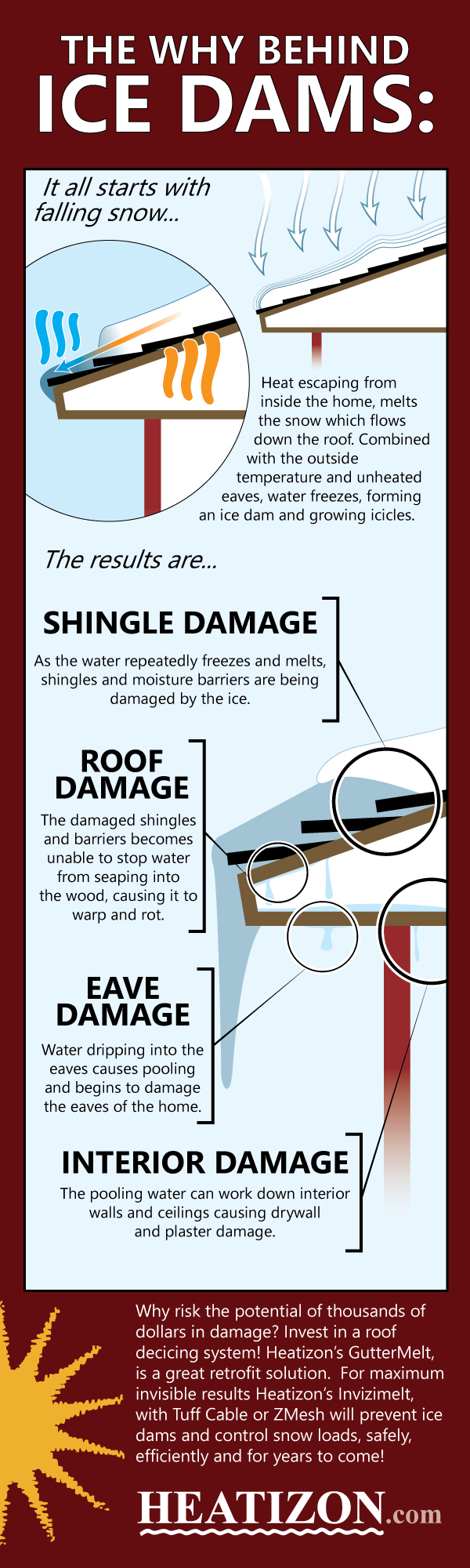
Icicles can be cool to look at and even slightly therapeutic to break off your gutters/eaves.  But do you know they are causing damage to your home? Icicles and accompanying ice dams could be causing thousands of dollars of damage to your home. Heatizon has created this infographic to explain “The WHY of Ice Dams.”

Heatizon.com ice dam prevention
Don’t suffer from ice dams anymore!

Check out Heatizon’s Ice Dam solutions.

ZMesh Under Hardwood Flooring

12” ZMesh Heating Element is the ideal system for heating under hardwood floors. ZMesh can be installed directly under the hardwood flooring. Nails or staples to hold the hardwood covering may be driven directly through the ZMesh as long as the nails or staples do not come in contact with any other metal object.

Allow the Hardwood to acclimate to the humidity level by bringing in the Hardwood several weeks before installation. This will minimize dimensional changes due to moisture. Install the ZMeah Heating Element to the subfloor and run a continuous continuity check to make sure the Zmesh is not damaged or shorting to something conductive. Let the System run for 2 to 3 days before nailing or stapling the Hardwood to the subfloor. It is very important to check with the manufacturer of the Hardwood before installing.

Read More

Radiant Heating System is All About Comfort, Warmth

As Seen in – Deseret Morning News
By: James Carpenter

Steve Love, a Salt Lake resident, is the owner of Hidden springs Ranch, a multi million dollar adventure resort located high in the hills east of Nephi in central Utah. His lodge was built from the ground up, using the finest materials available, including wood floors, tile and beautiful stone areas.

To bring comfort to the floors, Love installed an in-floor radiant heating system. “I wanted a heating system that would provide my guests with the most comfortable available, but that wasn’t too complex and didn’t require a lot of maintenance,” Love says.

Read More

ZMesh Radiant Heat

By Steven D. Bench
Managing Member
Heatizon Systems

When people associated with the radiant heating industry use the
words “ZMesh”, “Golden Mesh”, “Z Mesh”, or just plain “Mesh” they are referring to a
durable line of low voltage line electric products made by Heatizon Systems and used for
Radiant Roof Snow Melt and De-icing, Radiant Floor Warming and Radiant Heating.

Designed to be installed on and under sub-floors and on sub-roofs, ZMesh provides a
nice uniform heat and it is plenty robust to satisfy the demands of discriminating radiant
heat, radiant roof deicing, and radiant floor warming customers. In addition,

  • ZMesh – is gold in color and marquee in performance.
  • ZMesh – can withstand nails or screws as long as they do not short it to metal.
  • ZMesh – is made of durable bronze and warranted for 25 years.
  • ZMesh – is simple and easy to repair if it is cut or damaged.
  • ZMesh – requires little or no floor build-up.
  • ZMesh – can be installed under all non-conductive shingles and nearly all floor coverings.
  • ZMesh – is a cut to length in the field product rather than a fixed length product.
  • ZMesh – can be retro-fitted between floor joists from an unfinished basement or crawlspace.
  • ZMesh – is used for radiant heat, radiant floor warming, and radiant roof snow and ice melting.
  • ZMesh – is available in 9 and 12 inch widths and lengths from 50 to 400 feet long.
  • ZMesh – is plenty robust to heat entire spaces and eliminate ice dams.
  • ZMesh – has been tested to UL Standards and is listed by ETL.
  • ZMesh – is made in the United States of America.
  • ZMesh – is a term that has been trademarked by Heatizon Systems.

Heatizon Systems products are manufactured in Murray Utah, a suburb of Salt Lake City, and are marketed across the United States and Canada.

A Tuff Snow Job

By: Steve Smith

(Description of Heatizon Systems’ RPA Showcase Award Winning Project at the
Rothman Residence and Park City, UT)

You can count on two things when your home is located 8,500 feet or more above sea level in the Wasatch Mountains: snow and more snow.
To handle the snow loads on the roof of one 5,000-sq. ft., three-level home, electric radiant manufacturer Heatizon used a bronze mesh product called ZMesh, as well as its Tuff Cable embedded in a heat sink. The ZMesh is protected by a sandwich of ice and water shield, with composition asphalt shingle on the surface. The panel system allows for worry-free nailing. The ZMesh is energized by a step-down transformer, which produces a low voltage current that does not seek ground. The roof deicing system compromises approximately 520 sq. ft.
Meanwhile, a snow melting system using a low voltage resistance cable called Tuff Cable was embedded in the concrete in the window wells to prevent damage to the windows and interior finishes. There is approximately 400 sq. ft. of snowmelt in the window wells.

Heat Trace, Heat Tape or Something Else?

By Steven Bench

I received a telephone call this morning from a prospective customer wanting to
understand the difference between Heat Trace, Heat Tape, and GutterMelt. After
explaining the differences to him it occurred to me that perhaps others are confused so I
decided to write this article.

Heat Trace and Heat Tape are generic terms for a family of electric heating cables that
are designed to keep pipes from freezing, maintain the temperature of the contents of
pipes and melt snow and ice off of roofs and in drains, rain gutters and downspouts.
Some of the products in this family are designed to be installed inside of pipes and others
are designed to be wrapped around the outside of pipes, valves, and instrumentation.
Obviously the Heat Trace and Heat Tape products designed for rain gutters, downspouts
and on roofs are designed to be exposed to the elements including the rays from the sun.

Within the family of electric heating cables referred to as “Heat Trace” or “Heat Tape”
are Constant Wattage cables and Self Regulating cables. As you might have already
concluded Constant Wattage cables always put out approximately the same watts per
linear foot regardless of the temperature of their surroundings. The wattage output
per linear foot of Self Regulating cables on the other hand, varies dramatically as the
temperature surrounding the cable changes. As a matter of fact the wattage output of a
length of Self Regulating cable may vary as the temperature surrounding the cable varies
along its length.

The various brands of Constant Wattage Heat Trace or Heat Tape cables come in many
different quality levels and price points and are generally fixed in length. Design
longevity, temperature tolerance, and wattage output all dramatically affect quality and
price. Within the Constant Wattage segment of Heat Trace or Heat Tape, prices range
from less than a dollar to several dollars per foot, and life expectancy ranges from a year
or two to 10 or more years. The wattage output of Constant Wattage cables varies from a
few watts per foot up to 50 plus watts per foot.

Self Regulating cables are generally cut to length in the field products and like Constant
Wattage cables they are available in many different quality levels and price points. Like
Constant Wattage cables, the quality and price of Self Regulating Heat Trace or Heat
is dictated by the design longevity, temperature tolerance, and wattage output. These
cables generally have wattage outputs ranging from 3 to 24 plus watts per foot in a
certain medium (air, ice, water, etc.) and at a certain temperature.

Given that multiple outputs and many different types of cables are available on the
market much is to be gained to contacting an expert in the field when determining which
cable will best satisfy the objectives of your project.

Electric Floor Warming and Radiant Heating In California

By Steven D. Bench, Heatizon Systems

California’s Building Energy Standards, Title 24, Part 6 allows for the use of electrical radiant floor warming and electrical radiant space heating products whenever said products meet the definition of “supplemental heating.”

So what exactly is “supplemental heating?” According to the Building Energy Standards for the state of California “supplemental heating” is heating which is: (a) not the primary space conditioning system (defined as that system used in energy compliance analysis); and, (b) installed in an area that is also directly served by the primary space conditioning system. Of course common sense and the Building Energy Standards require that the primary space conditioning system have sufficient capacity to condition the entire building or home.

In other words, anytime the primary space conditioning system does not have sufficient capacity to condition the entire building or home, and/or the primary space conditioning system does not directly serve the space where the electrical radiant floor-warming or electrical radiant space heating product is to be installed, then said products are not considered “supplemental heating” and they must be included in the energy performance analysis to comply with the Building Energy Standards. As a result, the energy use of electrical floor warming and space heating products installed in areas such as bathrooms, that do not have supply vents from the primary space conditioning system, must be included in the energy performance standards compliance analysis.

The fact is that electric resistance space conditioning is difficult to justify as the primary space heater in California. The reason for this is that California uses source energy as the measurement for efficiency. As a result, even though electric products generally have energy efficiencies of 99 percent or greater, the efficiency of electric radiant floor warming and space heating products are reduced by the inefficiency of generating and delivering the electricity to the point of consumption.

The good news is Californians can enjoy the comfort and cleanliness of electric radiant floor warming and space heating anytime they have a primary system that has sufficient capacity to condition the entire space and the space is directly served by the primary system.

Roof Snow Melt and De-icing Systems

by Steven Bench

“Good grief, the last thing I thought I would need to worry about is a leaky roof!” Said the owner of a newly constructed Class A office building. “Why does my 2 year old metal roof have ice dam problems?” asked a homeowner that recently replaced a 10 year old cedar shake roof with a standing seam metal roof in an effort to get away from leaks. “The snow causes singles from my tile roof to fall off each winter!” proclaimed a home owner that purchased his tile shingle roofed home new 5 years ago. “How can I keep sliding snow from taking my rain gutters off??” inquired a condo complex property manager.

These are just a few of the questions that I get asked each week from people all over North America. Make no mistake; I am not in the roofing business! I am however in the business of warming things up. My company makes products that warms floors, heats buildings, melts now off of paved surfaces, melts snow and ice off of roofs and warms pipes and their contents.

Of course the simplest, but most impractical, solutions to cold weather caused roof and rain gutter problems is simply don’t build in places that experience snow and cold temperatures during the winter or, budget for, yet to be determined, roof and rain gutter repairs. But the best answer is to rely on a combination of design and snow melting technologies to offer long term solutions to the problems caused by snow and ice.

Many different snow and ice melting technologies are available on the market today, some have been around for years, and thus are tried and proven, while others are new and yet to be fully vetted. When selecting which product is best for any given application, it may be helpful to answer each of the following questions:

1) How important is the appearance of my home or building to me? Electric heating cables or hydronic tubing in an extruded metal pan system, electric heat trace, electric heat tape and all other on top of, or replacement for, the roof covering material and will affect the aesthetics of the building. If the unaltered appearance of your home or building is important to you then look at one of the low voltage under roof covering products available from you radiant heating and snow melting professional.

2) How important is product warranty in my decision? Generally roof covering materials have a life expectancy measured in years or decades. As a result, purchasers of roof covering materials usually expect long periods of trouble free service from the materials they select. It only makes sense that products designed to melt snow and ice off of the roof should also have long warranties and the purchasers ought to expect comparable performance from any other product installed under or on top of the roof.

Steven Bench is Managing Member of Heatizon Systems a Murray, Utah based manufacturer and marketer of low and line voltage electric heating and snow melting products.

My Winter Entertainment – Roof Snow & Ice Problems

By Heather Gwilliam

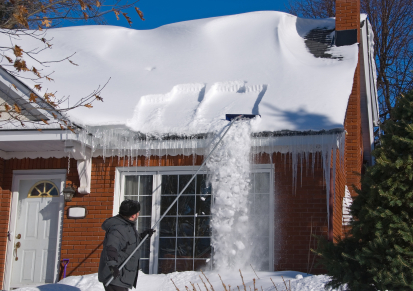
It’s that time of year where I get to sit back, peek out the window at my next door neighbor and enjoy my annual winter entertainment. It’s absolutely fascinating to watch him slowly and painstakingly remove the snow from his roof using a series of long handled rakes, brooms, and shovels.

I, on the other hand, eliminate ice and snow from my roof by flipping a switch and then settling back with a mug of hot chocolate to take pleasure in the show next door. Melting the snow on your roof with the flip of a switch, you say? How is that possible?

With a roof de-icing system from Heatizon Systems.

Cold temperatures and heavy snowfalls can quickly create dangerous and destructive conditions on the roofs of homes and buildings. Sharp icicles, thick layers of ice known as ice dams, and heavy snow slides cause millions of dollars in damage and injure hundreds of people every year.

Cosmetic Damage. The most obvious damage from snow storms is cosmetic damage, including damage to individual shingles, damage to gutters and fascia and other roofing elements. As the snow melts each day, some of the water re-freezes at night. As this cycle continues, ice can accumulate in valleys, gutters and at the eaves of the roof.

Thomas Remodeling says this freeze-thaw cycle is the cause of most of the cosmetic damage they see each year. Ice will expand in the gutters and cause seams to fail and the weight can bend and break the brackets holding the gutters to the home. Down spouts can split especially as water freezes in the down spout.

Structural Damage from Weight of the Snow. Another type of damage can occur from the sheer weight of the snow sitting on the roof and in the gutters. Not all snow is the same. The water content in heavy wet snow will be much greater than dry light snow. One cubic foot of heavy wet snow can weigh up to 20.81 pounds. That’s twelve inches of snow. Keep adding snow, and you can see how quickly the weight can add up. Excessive weight can lead to structural failure. It is no wonder that we see roof failures after major snow storms.

These types of structural failures are most often seen on commercial buildings with flat or low sloped roofing. Some of the worst collapses occurred where a winter storm was followed by a heavy rain some days later. The rain simply has no place to go.

Personal Injury.  Every winter, hundreds of injuries result from people trying to deal with winter roof woes.

Although attempting to clear heavy ice and snow from their roofs is a common occurrence, experience shows that it can also be dangerous. The Journal of American Insurance says that they’ve seen people do “some bizarre and even crazy things…over zealous homeowners continue year after year to attack these rooftop glaciers with an arsenal of household weapons that would have left General George S. Patton’s celebrated Third Army running for cover. These include, but are not limited to, ice picks, hammers, chisels, pickaxes, blow dryers, space heaters, shovels and brooms, garden hoses connected to household water heaters, and even panty hose stuffed with rock salt.

These household warriors, while brave and well intentioned, often don’t do themselves or their homes any good. Ventures onto slippery roofs in cold weather can exact a heavy toll in the form of bruises, broken bones and other serious injuries. Moreover, a homeowner armed with an ice pick or pickaxe has been known to cause more damage than if the roof had been left alone in the first place.” “As you can imagine, falls from roofs can cause very serious injuries, some of which are compensated by millions of dollars,” says attorney Michael Bersani. “Take it from me; my law firm and I have successfully won millions for workers who have fallen from roofs.”

Another source of injuries can happen when icicles, ice chunks or large amounts of snow suddenly and unmercifully slide off roofs onto walkways and entrances. One notable example of this type of injury took place in Dallas in 2011 when six people were hurt by snow falling off of Cowboy Stadium. One person suffered head trauma and a concussion, and five others were hospitalized.

Interior Damage from Ice Dams. Although the most obvious damage occurs on the exterior, with ruined shingles, fallen gutters and even roof collapses, some of the worst damage, takes place on the interior when ice and water penetrate roofing materials and create leaks.
”Ice dams are caused by heat escaping into an attic warming the underside of a roof, which melts the snow,” explains Daniel Morrison, Executive editor of Fine Homebuilding & Green Building Advisor. “The water runs down the roof until it gets past where the exterior wall is, and then it freezes — because the roof deck is no longer warm. The ice builds up and forms a dam as more water runs down onto it.”

The water beneath seeps into the cracks and crevices of the roof filling them with water, which expands when it freezes again, spreading the materials the roof is made from and creating gaps in the seal of the roof that keeps the building dry.

When those gaps become large enough, the roof will begin to leak, causing large amounts of water damage within the buildings structural interior which will require extensive repairs. If the damage is not addressed immediately, it can spread, causing a lot of damage to the structural integrity of the building.

Roof deicing and snow elimination systems help prevent the problems of ice and snow buildup around eaves, drains, valleys or entire roofs. These systems not only stop the damage caused by winter stress on a roof, but also remove the hazardous conditions of falling snow or ice and eliminate potential liabilities.

An effective system can prevent ice dams by heating the critical areas of a roof. The system maintains a consistent water flow off the roof or safely diverts melted water into heated gutters that drain into designated locations. This is achieved by having a uniform heat source properly installed.
“It’s important to prevent the buildup of snow and ice around roof eaves, drains, and valleys,” states Steve Bench, Managing Member of Heatizon Systems, based in Murray UT. Heatizon manufactures low-voltage electric radiant roof snow melt and deicing, radiant snow melting, radiant in-floor space heating and radiant floor warming systems.

An investment in a radiant heating system produces the perfect long-term solution to dangerous and destructive ice and snow build up on roofs, diminishing liability issues and increasing peace of mind. The Heatizon roof deicing and snow elimination system is the only way to permanently protect a home or building from winter woes.
Radiant Snow Melting For Sidewalks

by Steve Bench

Over the years, I have had three homes all with different sized sidewalks. My first home had a 3.5 foot wide sidewalk, the second one 4 foot wide and the third, and current, home has a 6 foot wide sidewalk. City and County sidewalks extending along the frontage of home lots are generally 3 feet wide but sometimes they are 4, 5 or even 6 feet wide. In downtown shopping areas it is not unusual to find sidewalks that are as wide as 10 or 15 feet. Needless to say sidewalks come in many different widths and lengths which are designed to handle different amounts of foot traffic and bridge different points.

Since sidewalks come in many different sizes and shapes it seems that the question, “How much does it cost to install a radiant snow melt system into a sidewalk?” has many different answers. Whenever a question has many different answers the potential for any particular answer conveying meaningful information decreases dramatically. So how does one go about finding out how much a radiant snow melting system installed in his or her future sidewalk cost?

The simple answer is to contact a reputable and professional manufacturer or supplier that has been in business for several years and has more resources that just a website, telephone and smooth taking salesman. A true professional radiant snow melting company will seek answers to the following questions prior to giving you a cost estimate.

  1. How wide and long is the sidewalk going to be?
  2. Is the sidewalk going to be made of concrete, asphalt, brick or stone pavers, ceramic tile, or other material?.
  3. How many strike, saw cut, crack control, cold and other joints will be in the sidewalk?
  4. Will insulation be installed under the sidewalk?
  5. Do you want the radiant snow melting system to be manually or automatically operated or both?
  6. Where is the geographic location of the sidewalk?
  7. How much and what kind of traffic is the sidewalk designed to handle?
  8. What energy sources do you have available to energize the radiant snow melting system?

Once a radiant professional has the answers to the above questions he or she can design and price a radiant snow melting system that satisfies the needs of the project. Until a radiant professional, or a website salesman for that matter, understands the answers to all of the above questions the best you are going to get is a guess that is either in or out of the ball park.