Heatizon’s patented aluminum panel system for metal roof, membrane, and all-roof deicing — UL 1588 listed, ¼ inch finished height, 100% heat utilization. Exclusive use with Tuff Cable.
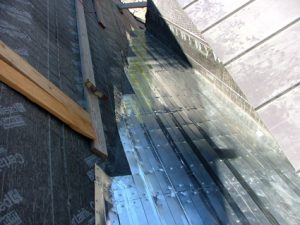
Invizimelt is Heatizon’s patented aluminum panel system for under-roof deicing — the only listed system in the United States and Canada for snow and ice melting installed under metal roofing, membrane, slate, and all other roof types. Tuff Cable low-voltage heating element snaps into the aluminum panels, which are installed on the roof deck beneath the finished roofing material, completely invisible in the completed installation. At ¼ inch finished height, metal roofing lays completely flat over the panels with no ridges, no bumps, and ample nailing surface for the roofing contractor. The system is exclusively used with Heatizon’s Tuff Cable and is ETL listed to UL Standard 1588 and CSA standards for under-roof applications in the US and Canada.
How Invizimelt works
The system begins with Tuff Cable snapped into the channels of the Invizimelt aluminum panels. Aluminum tape is then applied over the cable and across the full panel surface. Aluminum’s high thermal conductivity means heat from the cable spreads instantly and evenly across the panel face — directing 100% of the cable’s heat output upward through the roofing material above. Unlike cementitious heatsink materials that absorb heat slowly and lose a portion downward into the sub-roof, the Invizimelt aluminum panel wastes nothing.
The system heats from the drip edge up to the snowline — the point where interior building heat is already warming the roof from below. This continuous coverage eliminates the cold zone between the heated eave and the warm upper roof where meltwater typically refreezes, creating the ice dams and icicles that damage gutters, fascia, and building interiors. Unlike visible cable-on-roof systems that heat only a narrow strip at the eave, Invizimelt provides full coverage across the entire ice dam risk zone with nothing visible in the finished roof.
Compatible with every roof type
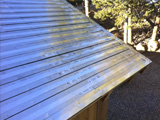
Invizimelt is the only listed deicing system compatible with all roofing materials — including standing seam metal, corrugated metal, membrane, slate, asphalt shingles, and composite shingles. It is the only system specifically listed and approved for installation under metal roofing, valley metal, and metal flashing, where ZMesh cannot be used due to its bronze mesh construction.
For non-metal roofing — asphalt shingles, wood shake, tile, and most membranes — ZMesh is the recommended alternative. ZMesh lays directly under shingles without any panel system, is approximately 1/16 inch thick, and shares the same UL 1588 listing and 25-year warranty as the Tuff Cable in Invizimelt. When a project includes both metal and non-metal roof areas, Invizimelt and ZMesh can be specified together for complete roof coverage from a single design and supply source.
See Heatizon’s roof deicing systems for the complete line-up of roof deicing products available.
New construction and retrofit
For new construction, Invizimelt panels are fastened to the roof deck and loaded with Tuff Cable before the roofing material is installed. The modular panel system assembles to cover eaves, valleys, crickets, dormers, and non-standard roof features at any pitch — Heatizon’s design team provides specifications outlining preliminary panel placement, Tuff Cable run spacing, and transformer sizing before installation begins.
For existing roofs, Invizimelt can be retrofitted in two ways. Panels can be installed over the roof edge shingle — sitting on top of the existing roofing at the eave line without any shingle removal. Or they can be installed under the roof edge shingle by lifting and relaying the lower courses of roofing material. The over-shingle retrofit is the faster method and requires no roofing disruption beyond the eave line. Both methods produce a fully functional, listed deicing system without a full re-roof.
Technical specifications
| Panel material | Aluminum — high thermal conductivity |
| Finished height | ¼ inch (0.25 inches) |
| Heat utilization | 100% — aluminum tape directs all heat upward through panel surface |
| Heating cable | Tuff Cable low-voltage, 10-gauge coated copper (exclusive) |
| Coverage area | Drip edge to snowline — full ice dam risk zone, no cold spots |
| Compatible roofing | All types — metal, membrane, slate, asphalt, composite shingles |
| System design | Modular — eaves, valleys, crickets, dormers; custom layout provided |
| Retrofit | Yes — over or under roof edge shingle, no full re-roof required |
| Safety listing | ETL listed to UL Standard 1588 and CSA standards — NRTL certified |
| NEC compliance | NEC Article 426 — only listed enclosed panel heating system |
| Patent | Patented Heatizon design |
| Moving parts | None — fully solid-state including control unit and activator |
| Activation | Automatic snow and ice detection; WIFI; and Manual available |
| Warranty | 25 years on Tuff Cable heating element (manufacturer) |
| Design assistance | Included — layout drawings (special projects), load calculations, project support |
| Country of origin | United States of America |
Why specify Invizimelt
Invizimelt is a patented Heatizon design — the aluminum panel system and its integration with Tuff Cable is a proprietary configuration not available from any other manufacturer. Combined with Tuff Cable’s ETL listing to UL Standard 1588 and CSA standards, the Invizimelt system is the only under-roof deicing assembly in the United States and Canada that is listed, code-compliant under NEC Article 426, and approved for installation under metal roofing. Architects, engineers, and contractors specifying under-metal-roof deicing for permitted construction have one listed option: Invizimelt with Tuff Cable from Heatizon.
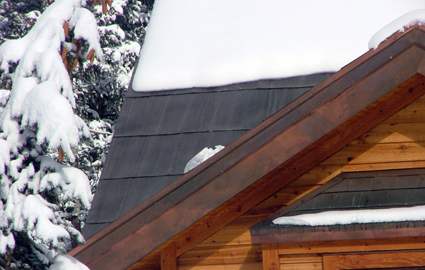
The ¼ inch finished height of the Invizimelt panel is an engineering achievement that competing systems have not matched. The main alternative in the aluminum panel category — IceFree’s Eave Panel — is not listed to UL Standard 1588, is not available in California, and is restricted to specialty metal roofing applications. Invizimelt carries a national listing, is available for supply and installation across the United States and Canada, and is compatible with all roofing types — metal, membrane, slate, asphalt, and composite.
Heatizon has manufactured the Invizimelt system in the United States since the company was founded in 1979. The system is solid-state with no moving parts — no wear components, no scheduled maintenance, and no expected service life limitation under normal installation conditions. The Tuff Cable heating element inside every Invizimelt system carries a 25-year manufacturer warranty, backed by decades of documented field installations that remain fully operational.
Proven in the field
Invizimelt has been installed on buildings across the United States and Canada since its introduction. One documented installation is the Museum of Natural Curiosity in Lehi, Utah — a commercial facility where Invizimelt was specified for roof valleys and eaves above exterior stairs, with the system providing a 2-foot-wide heat path on each side of the valley to prevent snow accumulation and ice dam formation. The finished metal roof shows no indication of the system installed beneath it.
Heatizon’s design team can even provide custom layout drawings for large commercial roof configurations with complex valleys, crickets, and dormers or other specialized projects.
Listed to UL Standard 1588 — the only under-roof deicing standard that matters
UL Standard 1588 governs Snow Melting and De-Icing Equipment. Achieving authorization under this standard for under-roof installation requires demonstrating that the system performs safely and reliably when permanently enclosed beneath roofing materials — a test no competing aluminum panel system has passed. The Invizimelt system, using Tuff Cable as the heating element, is ETL listed to UL 1588 and CSA standards by Intertek, an OSHA-recognized Nationally Recognized Testing Laboratory carrying equal legal standing to a UL listing in the United States and Canada.
This listing makes Invizimelt the only enclosed panel heating system compliant with NEC Article 426 for under-roof applications. For any project requiring a building permit in the US or Canada, Invizimelt with Tuff Cable is the only product that satisfies the code requirement. The ETL listing file is available on request from Heatizon for verification by engineers, inspectors, and authority having jurisdiction.
The Invizimelt system is ETL listed to UL Standard 1588 and CSA standards — independently certified by an OSHA-recognized NRTL.
Built by Heatizon — complete roof deicing from a single listed source
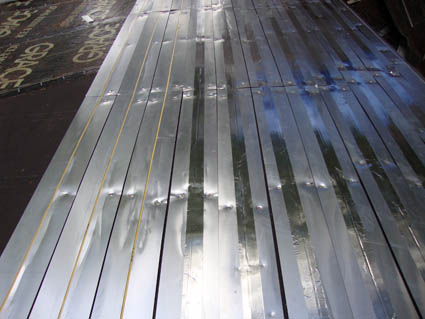
Heatizon Systems has designed and manufactured electric radiant heating products in the United States since 1979. The Invizimelt system is one of several listed, patented, or ETL-certified products Heatizon makes for under-roof applications — alongside ZMesh for non-metal shingle roofs and GutterMelt for gutters and downspouts. For projects requiring complete roof and drainage protection, Heatizon can design and supply every component from a single listed source.
Every Invizimelt system includes full project design assistance from Heatizon’s engineering team — Coverage estimates, Tuff Cable run calculations, transformer sizing, Installation guidance, and activation configuration — all included as standard. Heatizon provides unlimited technical support after commissioning with no time limit on post-installation support calls.
Complete the system
Every Invizimelt system uses Tuff Cable as the heating element — the same 10-gauge coated copper low-voltage cable with a 25-year warranty used across Heatizon’s snow melting and floor heating applications. For non-metal roof areas on the same building, ZMesh provides a listed under-shingle alternative that lays directly beneath non-conductive shingles without any panel system.
For complete building protection, pair the Invizimelt roof system with GutterMelt to keep gutters and downspouts clear — meltwater from the roof surface needs a clear drainage path all the way off the building. Heatizon can design and supply the complete roof deicing and drainage solution from a single listed source.
Frequently Asked Questions
Invizimelt with Tuff Cable Roof Deicing
Decks over a heated living space or roof present a secondary concern — meltwater from the deck can run down onto the roof beneath and refreeze, forming ice dams at the roof edge. Installing a roof deicing system on the roof below the deck — ZMesh for non-metal roofing or Tuff Cable in Invizimelt for metal roofing — ensures meltwater has a complete path off the building without backing up under the roof edge.
For non-conductive roofing materials — asphalt shingles, wood shake, tile, and most membranes — ZMesh is the recommended alternative. ZMesh lays directly under the shingles without any panel system, is approximately 1/16 inch thick, can be nailed and stapled through, and carries the same UL 1588 listing and 25-year warranty as the Tuff Cable in Invizimelt. Invizimelt with Tuff Cable is the correct choice for metal roofing, valley metal, flashing, and conductive surfaces where ZMesh cannot be used.
The Tuff Cable heating element within every Invizimelt system carries Heatizon’s industry-leading 25-year manufacturer warranty — 2.5 times the length of the standard 10-year warranty offered by competing heating cable products. The Invizimelt aluminum panels are a solid-state component with no wear parts and no expected service life limitation under normal installation conditions. Heatizon provides full technical support after commissioning with no time limit.
Yes. The Invizimelt system, using Tuff Cable as the heating element, is ETL listed to UL Standard 1588 and CSA standards — making it the only listed system available for under-roof snow and ice melting in the United States and Canada. This listing makes the Invizimelt system the only under-roof deicing product fully compliant with NEC Article 426 for enclosed panel heating applications. For permitted construction projects requiring a code-compliant under-roof deicing system, Invizimelt with Tuff Cable is the only listed option on the market.
Yes. The Invizimelt system — panels, Tuff Cable heating element, and control unit — contains no moving parts. The only mechanical action in the system is the automatic activator, which has no moving parts either, detecting snow and ice conditions electronically. A solid-state system with no moving parts has no wear components that require scheduled maintenance or replacement over the life of the installation.
Once Tuff Cable is snapped into the Invizimelt panel channels, aluminum tape is applied over the cable and panel surface. Aluminum’s high thermal conductivity means heat from the cable spreads rapidly and evenly across the full panel face, with no heat lost downward into the sub-roof below. The result is that essentially 100% of the electrical energy consumed by the Tuff Cable is converted to useful heat at the panel surface — making Invizimelt one of the most energy-efficient under-roof heating configurations available.
Invizimelt panels have a finished installed height of ¼ inch. This low profile means metal roofing panels, membrane, and other roof coverings lay completely flat over the Invizimelt system with no visible ridges or bumps in the finished roof. The ¼ inch height also provides ample surface for nailing and screwing metal roof panels — installers do not need to work around fastener locations when installing the roofing material over the panels.
Yes. The Invizimelt panel system is modular — panels come in different sizes and configurations that can be assembled to cover eaves, valleys, crickets, dormers, and other non-standard roof features. The modular format allows the system to be customized to any roof pitch or layout without cutting or fabricating custom components on site.
A complete Invizimelt system includes the aluminum panels in the sizes required for the project, Tuff Cable low-voltage heating element cut to length, aluminum tape for panel coverage, a control unit with monitoring functions, automatic snow and ice detection activator, and project specifications. Custom installation layout drawings from Heatizon’s design team are also available for some projects. The step-down transformer is sized and specified as part of the system design. Heatizon provides full project design assistance and technical support as part of every system.
The Invizimelt system is designed to heat from the drip edge up to the point where interior building heat is already warming the roof from below — the zone where snow naturally melts on its own. This design eliminates cold spots between the heated eave zone and the warm upper roof, preventing meltwater from refreezing mid-roof before it can drain. Unlike cable-on-roof systems that only heat a narrow strip at the eave, Invizimelt provides continuous coverage across the full ice dam risk zone. Heatizon’s design team specifies the exact panel coverage area based on roof geometry, insulation values, and local snowfall data.
Yes. Invizimelt can be retrofitted to existing roofs in two ways: panels can be installed over the roof edge shingle, sitting on top of the existing roofing at the eave line, or they can be installed under the roof edge shingle by lifting and relaying the lower courses of roofing material. The over-shingle retrofit method requires no shingle removal and is the faster installation — the panels are visible at the eave but concealed once any fascia or trim is in place. Both methods result in a fully functional, listed deicing system without a full re-roof.
On new construction, Invizimelt panels are attached to the roof deck along eaves, valleys, crickets, dormers, and other ice dam-prone areas. Tuff Cable is snapped into the panel channels and covered with aluminum tape, which directs 100% of the heat upward through the panel. Ice/Water shield is applied over the Invizimelt system, the Tuff Cable is marked, to ensure it is not punctured. Finally, the roofing material — metal, membrane, or other covering — is then installed directly over the panels. At ¼ inch finished height, the panels create no visible ridges or bumps in the finished roof surface, and provide ample nailing and fastening surface for the roofing contractor.
Yes. Invizimelt panels can be installed under deck surfaces as well as roofing materials — particularly where a solid subfloor is being used and the deck surface is stone, or some other continuous material needing a snow/ice melting system.
For snow melting systems for decks that installs on joists, please see our Deck Pan Heating System.
Invizimelt is compatible with all roofing materials — including standing seam metal roofing, corrugated metal, membrane roofing, slate, asphalt shingles, and composite shingles. It is the only listed system approved for installation under metal roofing surfaces. For non-metal shingle applications such as asphalt or wood shake where no panel system is needed, ZMesh is the recommended alternative — it lays directly under shingles without any panel or heatsink.
Aluminum transfers heat significantly faster than cementitious materials such as concrete or mortar. When Tuff Cable is covered with aluminum tape inside the Invizimelt panel, 100% of the cable’s heat output is directed upward into the panel surface — none is lost downward into the substrate below. A cementitious heatsink absorbs and stores heat more slowly and loses some of it downward into the sub-roof. Invizimelt’s aluminum construction means the system reaches operating temperature faster, responds more quickly to changing weather conditions, and uses energy more efficiently.
Invizimelt is Heatizon’s patented aluminum panel system for under-roof and under-deck deicing. Tuff Cable low-voltage heating cable snaps directly into the aluminum panels, which are then installed beneath the roofing or decking material — completely concealed from view. The aluminum panels act as a heatsink, rapidly distributing heat from the cable across the full panel surface and up through the roofing material above, melting snow and ice from the eaves, valleys, and roof edge before ice dams can form. Invizimelt is for exclusive use with Heatizon’s Tuff Cable.
Tuff Cable installed in Invizimelt Panels is compatible with all roofing materials — including metal roofing, non-metal shingles (asphalt, composite, wood shake, tile), membranes, valley metal, flashing, and metal drip edges. This makes Tuff Cable the more versatile of Heatizon’s two under-roof heating elements: where ZMesh is limited to non-conductive materials, Tuff Cable embedded in a heatsink works under any roof covering.
Invizimelt is Heatizon’s patented aluminum panel system designed for under-roof deicing. Tuff Cable snaps into the Invizimelt Panel channels, which then act as a heatsink — distributing heat evenly across the panel surface and up through the roofing material above. The aluminum construction provides rapid, efficient heat transfer compared to cementitious heatsink materials. Invizimelt Panels are modular, available in different sizes to fit varying roof pitches and valleys, and can be installed on new construction or retrofitted over the roof edge on existing roofs.
Yes. Tuff Cable, installed in Heatizon’s Invizimelt Panel, is the only listed system for snow and ice melting under metal roofing, valley metal, flashing, and metal drip edges. This under-metal-roof listing is covered under UL Standard 1588 and ETL certified — the same standard that makes Heatizon’s products the only under-roof systems compliant with NEC Article 426. Tuff Cable must always be fully embedded in the Invizimelt Panel for metal roof applications — it cannot be laid directly against metal roofing surfaces without a heatsink material.
Yes. Tuff Cable is the only low-voltage heating cable designed to withstand hot-pour asphalt installation. Its 10-gauge coated copper construction and chemical resistance allow it to survive the temperatures and chemical composition of freshly poured asphalt — making it the only practical low-voltage option for new asphalt driveway and roadway snow melting applications. In a two-pour asphalt installation, Tuff Cable is laid on the binder or base coat layer, and the final asphalt surface layer is poured directly over it.
Yes. Tuff Cable is listed by Intertek (ETL) — an OSHA-recognized Nationally Recognized Testing Laboratory — to UL and CSA standards for snow and ice melting on surfaces and roofs, and for interior floor heating applications. Together with ZMesh, Tuff Cable is one of only two products in the world authorized under UL Standard 1588 for snow and ice melting installed under roofing materials. All Heatizon systems are designed to ASHRAE standards for heating load calculation and energy efficiency.
Tuff Cable and ZMesh are both Heatizon low-voltage heating elements and both are ETL listed under UL Standard 1588 for under-roof snow melting — but they are designed for different installation methods. Tuff Cable is a round copper cable that must always be embedded in a heatsink material (concrete, asphalt, mortar, Invizimelt panel). ZMesh is a flat bronze mesh that lays directly beneath flooring or roofing without any embed. Tuff Cable is the right choice where a heatsink is present or required — driveways, metal roofs, floor overlays. ZMesh is the right choice where no embed is possible or desired — under non-metal shingles, hardwood floors, and carpet.
Tuff Cable carries an industry-leading 25-year manufacturer’s warranty — the longest available for any electric radiant heating cable in its category. The warranty reflects the cable’s construction: 10-gauge coated copper heating cable that gets embedded in a protective heatsink, with footage marks for verifiable installation, and a low-voltage design that reduces electrical stress on the insulation over time. Heatizon has documented installations from decades ago that remain fully operational.
Tuff Cable is a low-voltage system powered by a step-down transformer that reduces the supply voltage — typically 120V, 208V, 240V, or 277V AC — to 65 volts or less at the cable. This low operating voltage is one of Tuff Cable’s key safety advantages over line-voltage systems, and it also allows the cable to be cut and spliced in the field, and to be installed in surfaces where line-voltage systems are not permitted or practical.
