Electric snow melting systems like a heated driveway provide safe walking and driving surfaces without the hassle of traditional snow removal methods. Whether the surface is new-pour concrete, hot-pour asphalt, pavers, stone, or an existing surface being retrofit via saw-cut channels, Heatizon’s snow melting systems are engineered to provide long-lasting solutions for any exterior heating application. Custom tailored solutions without limitations, our systems are designed to the American Society of Heating, Refrigeration, and Air Conditioning Engineers Standards based on heat requirement data for local regions. We design our heating systems for quality, longevity, and warrantability.
A Heated Driveway Or Other Heated Surface Can Provide Convenience, Safety and Reliability

Did you know that our radiant heated driveway systems are maintenance free? Eliminate plowing, shoveling, icy spills, and potential damage to surfaces caused by plows and corrosive ice melt chemicals with Heatizon’s Tuff Cable or Hott-Wire radiant heating elements. Hott-Wire and Tuff Cable heating elements are ETL Listed to UL and CSA Standards for the United States and Canada.
We never set limitations on our radiant heated driveway systems by using the “one size and wattage fits all” design method that is all too often used in the electric resistance heating industry. With our design methods we ensure the highest performance and most economical system for our customers to purchase, always keeping the present and future electrical consumption costs in mind. Let us quote you first!
We have an exclusive, patented solution
for heating Pedestal Paver Systems!
We shoot for longevity and worry free reliability with our snow melting systems
Heatizon radiant snow melting systems are solid state, have no moving parts to wear out, and have nothing that requires routine maintenance. In addition, our quality electric snow melting systems are the longest lasting in the industry backed by industry leading warranties. An automated on/off temperature/moisture sensor will make your heated surface “worry free”.
Heatizon offers cost effective systems for heated surfaces
Our snow melting systems are designed to melt snow only when necessary and can be programmed to turn on automatically when snow is falling using advanced temperature and snow sensing controls. All systems are designed to ASHRAE standards using snow load data by region to give our customers the most efficient snow melting system available. We do not standardize our systems. Heatizon offers professionals, customized systems for residential, any any commercial or industrial application.
Why standardized snow melting systems are inferior to our customized snow melting systems?
- They are over designed for most regions especially for residential heated driveways
- They cause unneeded expensive operating costs and electrical service upgrades because they are usually over designed
- They can waste electricity due to over design
- They are difficult to repair since many do not use crack control joint jumpers incorporated into the design for new pour concrete applications
- There is typically minimal support for standardized systems due to lack of sales and technical training about design, operation, and installation of off the shelf one size fits all products
LET OUR PROFESSIONALS QUOTE YOU FIRST ON A HEATED DRIVEWAY OR OTHER SNOW MELTING SYSTEM!
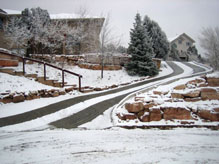

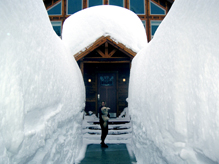
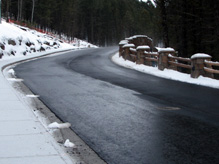
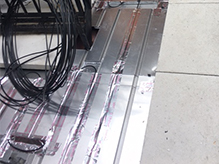
CAN USE:
–Tuff Cable
– Hott-Wire
CAN USE:
–Tuff Cable
– Hott-Wire
– SnowMeltz
CAN USE:
–Tuff Cable
– Hott-Wire
– SnowMeltz
CAN USE:
–Tuff Cable
– Hott-Wire
– SnowMeltz
CAN USE:
– Hott-Wire as
Part of the complete Pedestal system
CAN USE:
– Invizimelt
– Hott-Wire as
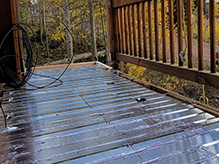
Part of the complete Deck heating system
For complete exterior protection, pair any snow melting system with GutterMelt to keep gutters and downspouts clear — meltwater from heated driveways and walkways needs a clear drainage path off the property.
Frequently Asked Questions
Snow Melting & Heated Surfaces
Small aluminum joist plates are included to protect the joists where the Hott-Wire cable crosses over them during installation. Because Hott-Wire is a line-voltage cable, direct contact with the wood joist at crossing points needs to be avoided — the joist plates sit between the cable and the joist surface at those points, protecting the wood and maintaining a safe installation. They are part of the complete system package.
Decks over a heated living space or roof present a secondary concern — meltwater from the deck can run down onto the roof beneath and refreeze, forming ice dams at the roof edge. Installing a roof deicing system on the roof below the deck — ZMesh for non-metal roofing or Tuff Cable in Invizimelt for metal roofing — ensures meltwater has a complete path off the building without backing up under the roof edge.
For decks adjacent to gutters or downspouts, pairing the deck pan system with GutterMelt keeps the full drainage path clear — meltwater from the heated deck needs to flow freely through gutters and downspouts to the ground. GutterMelt is recommended wherever deck meltwater drains into a gutter system.
Yes, There are a few secondary options are available for specific deck constructions. For decks with a concrete or mortar substrate — where embedding cable is feasible — Tuff Cable can be embedded directly in the substrate for even heat distribution. For decks with non-conductive wood or composite decking on traditional framing where no heatsink or pan system can be fitted, ZMesh or Invizimelt can be laid on a solid sub-deck beneath the decking. Both are secondary solutions; the deck pan system with Hott-Wire is Heatizon’s recommended and most complete deck deicing approach for wood-framed joist construction.
Yes. The deck pan system — pans, Hott-Wire cable, relay panel, and activator — contains no moving parts. No moving parts means no wear components, no scheduled mechanical maintenance, and no service requirements beyond verifying activation at the start of each winter season.
The system activates automatically via a snow and ice detection sensor that triggers heating when temperature drops below threshold and moisture is present — no manual switching required. A relay panel allows a single activation device to control multiple heating circuits across larger deck surfaces simultaneously.
The deck pan heating system supports 120V, 208V, 240V, and 277V supply voltages — compatible with most residential and commercial electrical configurations without requiring a transformer. Voltage is specified at the time of system design based on the project’s electrical supply.
Heavy-duty aluminum tape is applied over the Hott-Wire cable after it is routed into the pan channels. Aluminum’s high thermal conductivity spreads heat rapidly and evenly across the full pan surface, directing it upward through the deck surface above. Without the tape, heat would concentrate at the cable rather than distributing across the pan, reducing melting efficiency significantly. The aluminum tape is what makes the pan system an effective heatsink in addition to a simple cable holder.
The deck pan system uses Hott-Wire MI (mineral-insulated) fixed-length cable — a central copper conductor surrounded by fiberglass insulation inside a copper outer tube and HDPE jacket, with cold leads factory pre-connected at both ends. The MI variant’s construction withstands the mechanical loads of deck installation and delivers consistent, reliable heat output over the life of the installation. Factory pre-connected cold leads eliminate field splicing during installation.
Every Heatizon deck pan heating system includes Hott-Wire heating cable, insulated aluminum heating pans, joist plates, heavy-duty aluminum tape, a relay panel, and an automatic snow and ice detection activator. Each system is custom-configured to the project’s dimensions, joist spacing, voltage, and decking material.
Aluminum insulated heating pans are placed over two joist gaps (24″ or 32″), notches are made to install joist protection plates where the heating cable crosses any wood. Next, Hott-Wire MI line-voltage cable is then routed through the pan channels and covered with heavy-duty aluminum tape, which spreads heat rapidly and evenly across the full pan surface and directs it upward into the deck surface above. The deck face is installed on top — screws or nails can pass through the aluminum pan or between adjacent pans to secure the decking to the joists below.
All Hott-Wire systems are custom-designed to ASHRAE standards — the American Society of Heating, Refrigeration and Air-Conditioning Engineers’ snow melting data provides region-specific watt-per-square-foot targets that account for local snowfall rates, ambient temperatures, and wind exposure. Cable spacing is calculated to meet the required watt density for the installation region. The MI variant must be ordered to exact length once the design is finalised; the self-regulating variant can be cut to length on site. Contact a Heatizon distributor to begin the design process for your project.
Hott-Wire snow melting systems are activated by a relay panel or contactor panel, which allows a single activation device to control multiple heating circuits simultaneously — essential for larger commercial installations covering thousands of square feet. Smaller systems can connect the activation device directly to the heating element without a separate relay panel. Automatic snow and ice detection sensors are the recommended activation method, triggering the system when temperature drops below 38°F and moisture is detected — eliminating the need for manual switching. More advanced activation methods, WIFI, weather-predicting, and BAS/BMS integration is also available.
Yes. Hott-Wire can be retrofitted into existing concrete and asphalt surfaces using a saw-cut method — channels are cut into the existing surface, the cable is laid into the channels, and the surface is patched with a compatible overlay material. This approach delivers performance comparable to a new-pour installation without the cost and disruption of full surface removal and replacement.
Like Tuff Cable, Hott-Wire systems use jumpers — steel and aluminum brackets covering the Hott-Wire cable — to protect the cable where it passes through concrete crack control joints and expansion joints. The jumper encases the cable so slab movement cannot apply mechanical stress to the heating element at the joint location. Proper jumper installation at every joint is essential for long-term system reliability in concrete applications.
Hott-Wire can be installed in new-pour concrete, hot-pour asphalt, sand or stone dust beds under pavers, and retrofit into existing concrete or asphalt surfaces via saw cut. Its MI construction withstands the temperatures and pressures of hot-pour asphalt installation — a capability shared with Tuff Cable but not available in most competing line-voltage heating cables. Hott-Wire is suitable for driveways, walkways, parking areas, loading docks, ramps, stairs, and any other paved exterior surface requiring snow melting.
Choose MI Hott-Wire for large commercial and industrial surfaces, projects with high snow load requirements, installations in severe northern climates, and any application where maximum watt output and long-term performance are the priority. MI cable delivers consistent, precise output regardless of temperature and is the more durable long-term option. Choose self-regulating Hott-Wire for smaller or irregularly shaped areas, retrofit projects where the exact layout isn’t finalised before ordering, or applications in milder climates where the lower maximum output of self-regulating cable is sufficient. Contact a Heatizon distributor to determine the right variant for your specific project.
Self-regulating cable automatically adjusts its heat output based on the surrounding temperature — producing more heat when conditions are colder and less when they are warmer. This means the cable never overheats and cannot be damaged by overlapping or bundling, making installation more forgiving than fixed-output MI cable. Unlike the MI variant, self-regulating Hott-Wire is cut to length in the field — no pre-ordering to exact specifications required. The tradeoff is that self-regulating cable has lower maximum output than MI cable and is typically chosen for applications where the installation layout is less predictable or where the moderate output of a self-regulating system is sufficient for the climate and surface area.
Yes. The mineral-insulated Hott-Wire cable is a fixed-length product — it is manufactured to the exact length required for the project and cannot be shortened or extended in the field. This requires the system to be designed and sized before the cable is ordered. Watt output per lineal foot is determined by project requirements — spacing between runs is calculated to meet the ASHRAE snow melting watt-per-square-foot target for the installation region. The self-regulating variant of Hott-Wire, by contrast, is cut to length in the field.
Cold leads are the non-heating cable sections that connect the heating element to the electrical panel. On standard MI cables, cold leads must be spliced onto the heating element on-site during installation — a process that requires special tools, adds labor time, and introduces a potential failure point at the splice. Hott-Wire’s MI cable comes with cold leads pre-connected at the factory, eliminating field splicing entirely. The installer simply routes the cold leads from the heating zone to the panel and terminates them — a straightforward connection with no specialized splicing equipment required.
Most MI cables use magnesium oxide (MgO) as the mineral insulation — but MgO is hygroscopic, meaning it absorbs moisture from the environment over time. Moisture absorption degrades the insulation and can eventually cause cable failure. Hott-Wire uses inert fiberglass insulation instead, which does not absorb moisture. This makes Hott-Wire more resistant to the humidity and freeze-thaw cycles encountered in outdoor snow melting installations, and contributes directly to its 10-year warranty longevity. This is a specific engineering improvement over standard MgO MI cable construction.
A mineral-insulated (MI) heating cable consists of a central metal conductor surrounded by a compressed mineral insulation — in Hott-Wire’s case, inert fiberglass — encased in a copper outer tube and coated with an HDPE jacket. MI cable technology was first patented in 1896 and has been used in critical applications including nuclear reactors, fire alarm systems, military equipment, and emergency infrastructure precisely because of its extraordinary durability and resistance to mechanical damage, high temperatures, and moisture. Heatizon’s Hott-Wire brings this industrial-grade construction to snow melting applications, engineered specifically for radiant heating performance.
Yes. Hott-Wire is ETL listed for snow and ice melting applications — certified by Intertek, an OSHA-recognized Nationally Recognized Testing Laboratory carrying equal legal standing to UL and CSA listings in the United States. All Heatizon systems are designed to ASHRAE standards for snow melting load calculations by region.
Hott-Wire carries a 10-year manufacturer’s warranty — the longest available in the line-voltage mineral-insulated heating cable category. The warranty is backed by the cable’s MI construction: a copper conductor in fiberglass insulation inside a copper tube, which provides exceptional resistance to moisture, mechanical damage, and the temperature extremes encountered in outdoor snow melting applications.
Hott-Wire operates at line voltage — 208V, 240V, or 277V AC supplied directly from the building’s electrical panel. Hott-wire MI can also accommodate 480V and 600V (Canada). Smaller systems typically use a 208V, 240V, or 277V supply with a 30-amp breaker; larger area installations use a double-pole 40-amp breaker. Unlike Heatizon’s Tuff Cable, Hott-Wire does not require a step-down transformer — the cable connects directly to the line voltage supply through a relay or contactor panel.
The primary difference is voltage. Tuff Cable is a low-voltage system — it operates at 65 volts or less via a step-down transformer, making it well suited to mid-size residential and commercial projects and roof deicing applications. Hott-Wire is a line-voltage system running at 208V, 240V, or 277V directly from the supply — no transformer required — making it more practical for large commercial and industrial snow melting surfaces where higher wattage output and simpler electrical integration are priorities. Both cables can be installed in concrete, asphalt, pavers, and retrofit saw cuts, and both are rated for hot-pour asphalt. Tuff Cable also carries a UL 1588 listing for under-roof applications; Hott-Wire does not.
Hott-Wire is Heatizon’s line-voltage electric snow melting and radiant heating cable — available in two configurations. The first is a mineral-insulated (MI) fixed-length cable: a central copper conductor surrounded by fiberglass insulation compressed inside a copper tube with an HDPE jacket, factory-terminated with pre-connected cold leads. The second is a self-regulating cut-to-length cable that automatically adjusts its heat output based on ambient temperature. Both variants run at line voltage — 208V, 240V, or 277V (480 and 600 volts for the MI version) — without a step-down transformer, and both are custom-designed to ASHRAE standards for each project.
All Tuff Cable snow melting systems are custom-designed to ASHRAE standards, taking into account the project’s geographic location, local snowfall data, surface area, and slab type. Heatizon’s design team calculates the required wattage, run spacing, and transformer sizing for each project. This design service is included with every Tuff Cable system and is provided before materials are ordered. Layout drawings can be provided for special circumstances and/or large/specified projects.
Tuff Cable is suitable for snow melting in concrete, asphalt, mortar beds under pavers or stone, and overlay systems over existing surfaces. It is used for driveways, walkways, entryways, parking areas, loading docks, stairs, and ramps — both residential and commercial. It can also be installed under pavers in a sand or mortar bed, and can be retrofitted into existing concrete or asphalt via saw cut.
Yes. Tuff Cable can be retrofit into existing concrete and asphalt surfaces using a saw-cut method. Channels are cut into the existing surface, Tuff Cable is laid into the channels, covered with a backer rod, and the surface is patched with a compatible overlay material and/or a sealant. This retrofit approach delivers performance equivalent to a new-pour installation at a fraction of the cost and disruption of full removal and replacement. Heatizon’s design team provides retrofit layouts and specifications as part of the standard project design service.
The Joint Jumper Kit is a Tuff Cable-exclusive accessory that allows the heating element to safely bypass expansion joints and control joints in concrete installations. Without it, running a heating cable directly through a concrete joint creates a stress point where cracking or movement in the slab can damage or sever the cable. The Joint Jumper Kit connects the Tuff Cable to a cold lead that passes under the joint, then reconnects to the Tuff Cable on the other side — allowing the concrete to move and shift without putting mechanical stress on the heating element. This makes Tuff Cable the only snow melting cable that can be reliably installed across multi-section concrete slabs, stairways, and driveways with multiple expansion joints.
Yes. Tuff Cable is the only low-voltage heating cable designed to withstand hot-pour asphalt installation. Its 10-gauge coated copper construction and chemical resistance allow it to survive the temperatures and chemical composition of freshly poured asphalt — making it the only practical low-voltage option for new asphalt driveway and roadway snow melting applications. In a two-pour asphalt installation, Tuff Cable is laid on the binder or base coat layer, and the final asphalt surface layer is poured directly over it.
Yes. Tuff Cable is listed by Intertek (ETL) — an OSHA-recognized Nationally Recognized Testing Laboratory — to UL and CSA standards for snow and ice melting on surfaces and roofs, and for interior floor heating applications. Together with ZMesh, Tuff Cable is one of only two products in the world authorized under UL Standard 1588 for snow and ice melting installed under roofing materials. All Heatizon systems are designed to ASHRAE standards for heating load calculation and energy efficiency.
Tuff Cable and ZMesh are both Heatizon low-voltage heating elements and both are ETL listed under UL Standard 1588 for under-roof snow melting — but they are designed for different installation methods. Tuff Cable is a round copper cable that must always be embedded in a heatsink material (concrete, asphalt, mortar, Invizimelt panel). ZMesh is a flat bronze mesh that lays directly beneath flooring or roofing without any embed. Tuff Cable is the right choice where a heatsink is present or required — driveways, metal roofs, floor overlays. ZMesh is the right choice where no embed is possible or desired — under non-metal shingles, hardwood floors, and carpet.
Tuff Cable carries an industry-leading 25-year manufacturer’s warranty — the longest available for any electric radiant heating cable in its category. The warranty reflects the cable’s construction: 10-gauge coated copper heating cable that gets embedded in a protective heatsink, with footage marks for verifiable installation, and a low-voltage design that reduces electrical stress on the insulation over time. Heatizon has documented installations from decades ago that remain fully operational.
Tuff Cable is a low-voltage system powered by a step-down transformer that reduces the supply voltage — typically 120V, 208V, 240V, or 277V AC — to 65 volts or less at the cable. This low operating voltage is one of Tuff Cable’s key safety advantages over line-voltage systems, and it also allows the cable to be cut and spliced in the field, and to be installed in surfaces where line-voltage systems are not permitted or practical.
Tuff Cable is a low-voltage electric radiant heating cable made from a specially-engineered copper heating wire (approximately 10-gauge), manufactured by Heatizon Systems. It is chemical and gasoline resistant, comes with footage marks printed along the cable for easy layout verification, and is designed to always be embedded in a heatsink material — such as concrete, asphalt, mortar, stone, pavers, or Heatizon’s Invizimelt Panel. Tuff Cable is a cut-to-length product, giving installers precise control over system sizing without material waste.
Yes. For complete winter weather protection on a rooftop or elevated deck, the pedestal paver system integrates naturally with other Heatizon products. Invizimelt and ZMesh can protect surrounding roof membrane and low-slope areas, while GutterMelt addresses gutters and downspouts. Using these systems together eliminates all potential drainage blockage points in a single, coordinated installation.
Snow and ice accumulation on rooftop pedestal paver installations can block drainage pathways, leading to standing water, ice dams, and structural loading concerns. Heatizon’s system melts snow and ice at the paver surface, allowing meltwater to flow freely through the gaps between pavers and into the roof’s drainage system. For complete drainage protection, the pedestal paver system can be combined with Heatizon’s Invizimelt, ZMesh, or GutterMelt products to address drains, gutters, and surrounding surfaces.
Yes. Heatizon offers full project design assistance and ongoing project support for pedestal paver snow melting installations. This includes reviewing project drawings, calculating heating loads, confirming paver and pedestal compatibility, and providing installation layouts. This service is included with the system package and is designed to ensure correct performance from installation through operation.
The Heatizon pedestal paver snow melting system is sold as a complete, patented package. Each package includes: the insulated heating pans, the Hott-Wire line-voltage mineral-insulated heating cable, GFEP-protected relay panel(s), an automatic snow/ice detection activator, installation layout drawings, and select accessories. Note that pedestals themselves are not included, as these are typically sourced separately based on project specifications.
Heatizon’s snow melting system is compatible with leading pedestal systems used in commercial and residential construction. The system ships with project-specific layout drawings to ensure correct fit. Contact Heatizon’s design team for confirmation of compatibility with a specific pedestal brand or profile.
The Heatizon pedestal paver system accommodates several common paver sizes. Because the heating pan is engineered to fit beneath the paver rather than being embedded in it, variations in paver dimensions are not an obstacle. Heatizon’s design team provides system layouts specific to each project, confirming compatibility with the pavers and pedestal system in use before installation begins.
Yes. Heatizon’s pedestal paver heating system is designed to be retrofitted into existing pedestal paver installations. The heating pans are sized to accommodate a range of common paver dimensions, so in most cases the pavers can be lifted, the pans installed beneath them, and the pavers relaid — without requiring full demolition or replacement of the pedestal substructure.
Heatizon’s pedestal paver snow melting system supports 208V, 240V, 277V, and 480V supply voltages. This range of compatibility ensures the system can be integrated into most commercial and residential electrical configurations without requiring a dedicated transformer or voltage conversion.
The Heatizon pedestal paver system uses an custom engineered aluminum insulated pan that sits directly beneath each paver. The Hott-Wire heating cable runs inside the pan, and because the pan is insulated on the underside, heat is directed upward into the paver rather than lost downward. This focused transfer makes the system more energy-efficient than systems without directional insulation, and allows the paver surface itself to act as the melting surface.
A pedestal paver snow melting system is an electric radiant heating solution designed for elevated, open-air spaces where pavers sit on adjustable pedestals — such as rooftop terraces, decks, and plaza surfaces. Heatizon’s patented system fits an insulated heating pan beneath each paver, containing a Hott-Wire mineral-insulated heating cable. When activated, the cable heats the pan, which transfers warmth directly up through the paver surface to melt accumulated snow and ice, keeping drainage pathways clear and the space safe to use year-round.
MI Cables were first invented in 1896 and have been in use since the early 1900’s. These durable cables are a reliable system and Hott-Wire has been specially engineered for radiant heating being resistant to water absorption. The inert fiberglass reduces cable breakdown unlike Magnesium Oxide MI Cables. Hott-Wire has been sold worldwide.
The average operational cost for a snow melting system is approximately $0.18 per 100 square feet per hour. This figure is based on a system producing 22 watts/sq. ft. or 73.7 BTU’s/sq. ft. with a kwh rate of $0.08 per hour (the national average kwh is $0.08/hour). If you know the square feet of the area you wish to heat and your kwh rate, you can calculate the operational costs with this formula: heatable sq. ft. times watts/sq. ft., divided by 1000, times your kwh rate.
Hott-Wire systems can be activated with an aerial mounted moisture and temperature sensor, temperature sensor, pavement-mounted snow sensor, or 12 hour timer. The aerial and pavement mounted sensor will automatically turn on when the temperature is below 38 degrees and there is moisture on the sensor. Heatizon has its own engineered relay panel (M330) offering 30Amp or 50Amp relay switches for single activation of multiple circuits.
The power requirements vary from system to system. Generally Hott-Wire heating systems require a 208, 240, or 277 volt supply 30 Amp breaker for smaller areas. For larger areas a double pole 40 Amp breaker is used. Systems are designed to ASHRAE standards and vary in size and load depending on region and application
Hott-Wire is a resistance Mineral Insulated heating cable that is very durable. Hott-Wire is a fixed length line voltage element consisting of a central single or dual conductor surrounded by fiberglass inert insulation compressed in a Copper tube, which is coated with an HDPE Jacket. Hott-Wire has been engineered to work as a line voltage system.
Since 1979, Tuff Cable systems have been sold worldwide and are still in operation, worry free.
Tuff Cable comes with an industry leading, 25-year manufacturer’s warranty.
Tuff Cable is ETL Listed for snow and ice melting on surfaces and roofs and for interior floor heating applications.
Tuff Cable systems can be activated with an aerial mounted moisture and temperature sensor, temperature sensor, pavement-mounted snow sensor, or 12 hour timer. The aerial and pavement mounted sensor will automatically turn on when the temperature is below 38 degrees and there is moisture on the sensor.
Tuff Cable heating element is the perfect choice for snow melting in driveways, sidewalks and stairs. Tuff Cable systems can be installed in new pour concrete, under tile or pavers in a sand bed, and can be retrofitted into existing concrete or asphalt.
Tuff Cable is a resistance heating wire that is very durable, 10 gauge coated copper cable that is chemical resistant and comes with footage marks on the wire. The Tuff Cable has been engineered to work as a low-voltage system.
Tuff Cable can be retrofit in any asphalt, concrete, or cementitious base.
