Blog

Install Activation Device

Heatizon activation devices come with data sheets, wiring diagrams, and instructions. Install the selected activator by carefully following the specific set of instructions that were included with the activation device. Some systems are professionally designed and can include custom wiring diagrams from our industry professionals. There are three available types of activators that are suitable for SnowMeltz®:

SMZ-activators Install Activation Device
  • MANUAL – Manual activators usually consist of a timer switch that keeps the system on for a set amount of time, then powers off the system. This activator requires some sort of panel (regardless of the number of circuits) to switch the load.
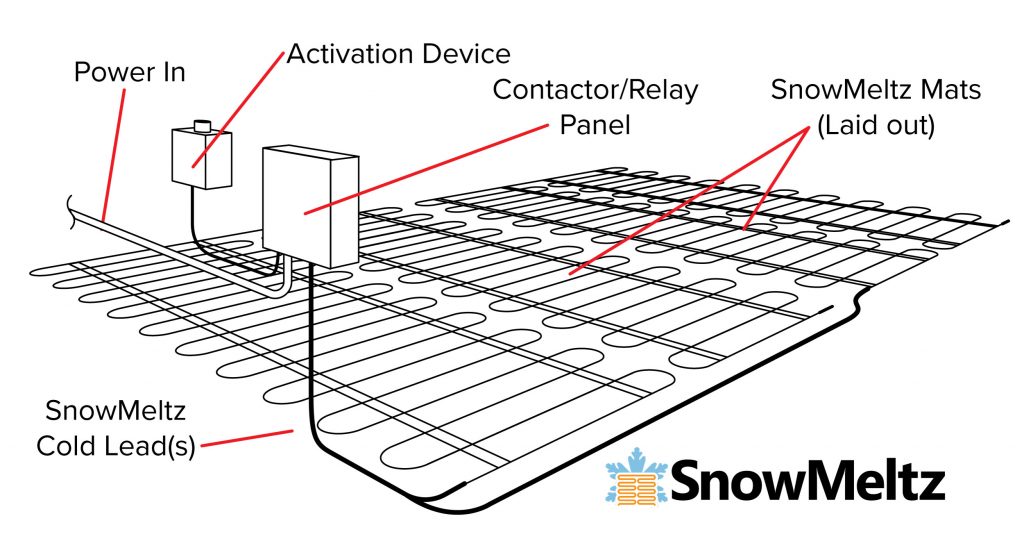
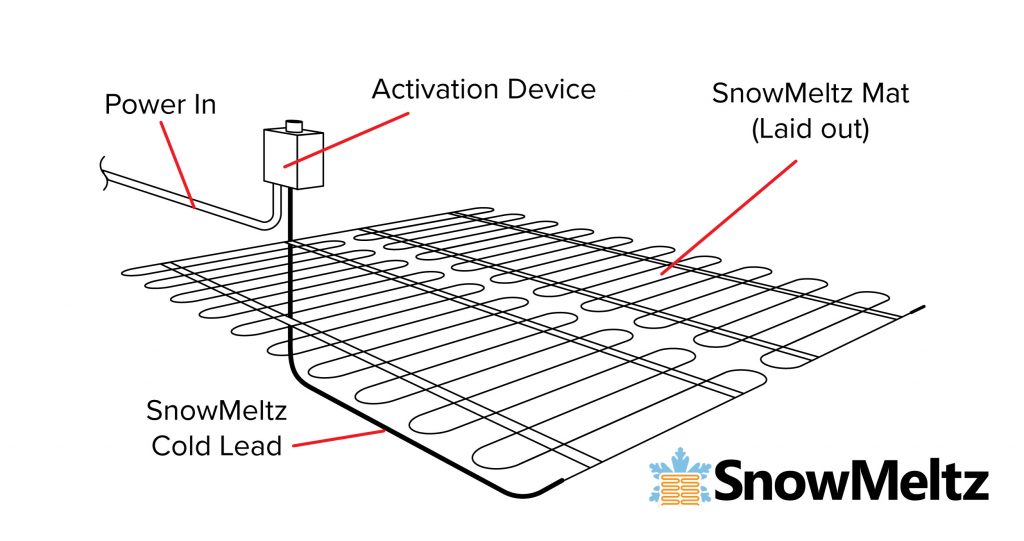
  • AERIAL – These activators are mounted on a wall or on a conduit in the air in very close proximity to the area to be heated. They can be equipped with temperature and/or moisture sensors, and usually have some form of basic manual override. Depending on the model, it may be able to switch smaller loads (30 amps) without the use of a panel. The sensor for this device must be able to detect the same circumstances that will be present in the area where the SnowMeltz® is installed.
  • REMOTE/IN-GROUND – The activators usually have a head unit located indoors and have more functionality and have optional in-ground sensors that detect moisture/temperature on on the concrete/asphalt. These units can also have separate remote temperature sensors. Normally these units require a panel to switch the load. When using in-ground sensors, the conduit for the sensor wire and head unit must NOT cross or come in contact with the heating element. The sensor must be mounted in the SAME substrate as the SnowMeltz® system is installed into. When using a remote temperature sensor, it should be located to receive the same conditions as the heated area.

It is imperative that any/all conduit being used (for sensors, cold leads, power, etc.) do NOT come in contact with the heating element. Consult the individual instructions for the appropriate activator for wiring/mounting. Quick start/Wiring Diagrams for the most popular Heatizon activation devices are included on pages 20-23.

  • If the selected activation device requires conduit for a temperature sensor, the conduit must be centered between two runs of heating cable. Always run high voltage and low voltage conductors in separate conduits.
  • Heatizon recommends that photographs of the installed heating cable be taken and/or hand drawings documenting the layout be completed prior to installing the final surface.

Jump to a section

Installation

Concrete Preparation:

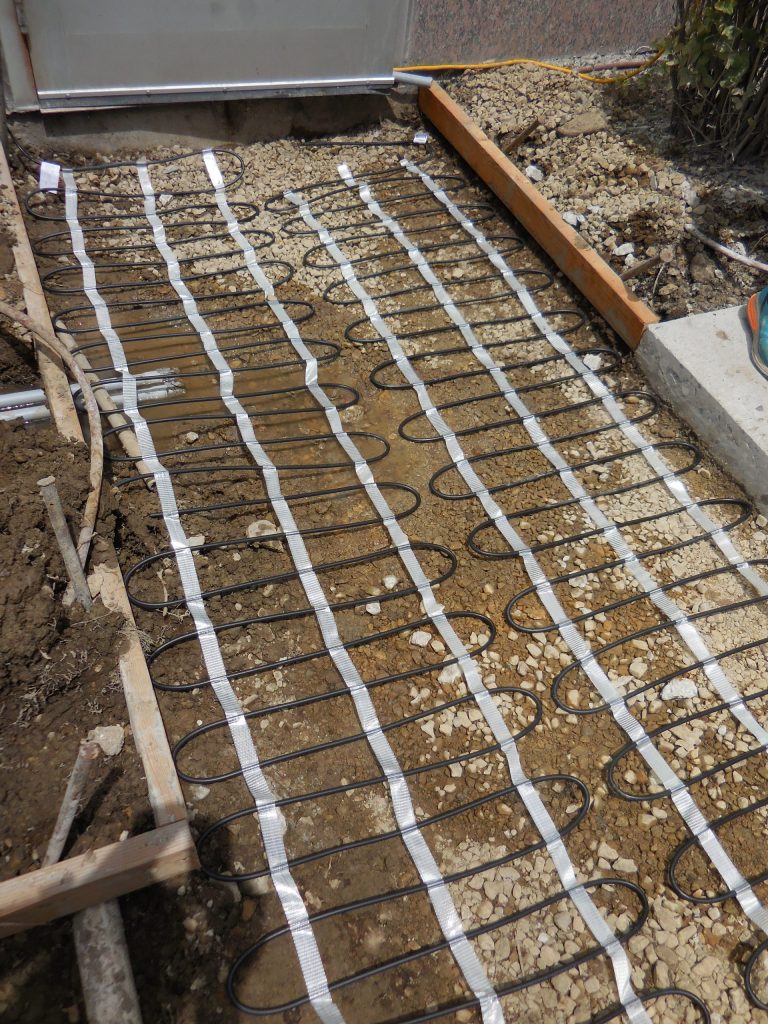
Loose heating cable not in a mat may be secured in place by landscape stakes and plastic wire ties, welded wire fabric and plastic wire ties or tape, or pre-punched steel straps purchased from your Heatizon Distributor or Representative. Do not compress or strain the cable, run heavy machinery, equipment, or vehicles over it. Be careful to avoid stepping on the cold section factory connection of the cable. Consult the NEC or CEC for grounding requirements of rebar or welded wire fabric for concrete installations. When working with concrete or asphalt joints, design the layout so each section of the slab is covered and the cable crossing of joints are minimized. See page 15 for example layouts. Mats should be installed in evenly spaced runs per the system design and plan. Sleeve hand rail posts to avoid drilling or penetrations in the slab after the pour.

DSCN1821-scaled-e1646176755622-768x1024 Installation
  • Two Pour Concrete: In this installation a concrete slab is already present and an additional slab will be poured on top. The heating cable can be layed out using welded wire fabric and zip ties or tape, or pre punched steel strapping for loose cable installations not in a mat form. Cold leads should be sleeved for this installation following conductor fill and size requirements in the NEC and CEC. The heating cable portion and cold connection can not pass into the conduit sleeve. Jumpers must be used to protect the heating cable where joints are present on the concrete slab below as well as in the new slab.
  • Single Pour Concrete: In this installation the aggregate or concrete base is prepared first. Once the base is prepared the installer can begin by placing a grid of welded wire fabric or rebar in preparation for the heating cable. The heating cables or mats can be attached to the welded wire fabric with plastic zip ties or tape. Take note of layout examples on page 9 for installations requiring jumpers. Jumpers must be used for any and all joint cable crossings. Do not cross expansion joints. Once the heating cable is installed, place chairs or concrete dobies under the rebar or welded wire fabric grid to bring the heating cable within 2” to 3” of the surface. Cold leads can be sleeved following conductor and fill size requirements in the NEC and CEC. The heating cable portion and cold connection can not pass into any conduit sleeve.

Asphalt Preparation:

Loose heating cable not in mat form may be secured in place by landscape stakes and plastic wire ties, welded wire fabric and plastic wire ties or tape, or pre-punched steel straps purchased from your Heatizon Distributor or Representative. Cables in a mat can be layed out in the configuration desired directly on the surface. Do not compress or strain the cable, run heavy machinery, equipment, or vehicles over it. Be careful to avoid stepping on the cold section factory connection of the cable. Consult the NEC or CEC for grounding requirements of rebar or welded wire fabric for asphalt installations. When working with concrete or asphalt joints, design the layout so each section of the slab is covered and the cable crossing of joints are minimized. See page 9 for example layouts. Cables or mats should be installed in evenly spaced runs per the system design and plan. Sleeve hand rail posts to avoid drilling or penetrations in the slab after the pour.

  • Two Pour Asphalt: In this installation a binder or base coat of asphalt is layed down and an additional asphalt layer is placed on top of the heating cable. The base coat is to be rolled smooth in preparation of the heating cable installation. Welded wire mesh can be used to install loose cables in a grid. The grid can be secured to the base coat slab using stakes. If using a heating cable in mat form, the mats can be layed out on the base coat slab and secured down using the mesh portion of the mat and not the heating cable. Cold leads should be sleeved for this installation following conductor fill and size requirements in the NEC and CEC. The heating cable portion and cold connection can not pass into the conduit sleeve. Jumpers must be used to protect the heating cable where any and all joints are present. Do not cross expansion joints.
  • Single Pour Asphalt: In this installation the aggregate or base is prepared first. Once the base is prepared, a layer of sand or stone dust is placed over the base coat approximately 1” thick. The installer can begin by placing a grid of welded wire fabric or landscaping stakes in preparation for the heating cable. The heating cables or mats can be attached to the welded wire fabric, or landscaping stakes with plastic zip ties that will not melt. Take note of layout examples on page 11 for installations requiring jumpers. Jumpers must be used for any and all joint cable crossings. Cold leads should be sleeved following conductor and fill size requirements in the NEC and CEC. The heating cable portion and connection can not pass into any conduit sleeve.

Sand Bed Paver Preparation:

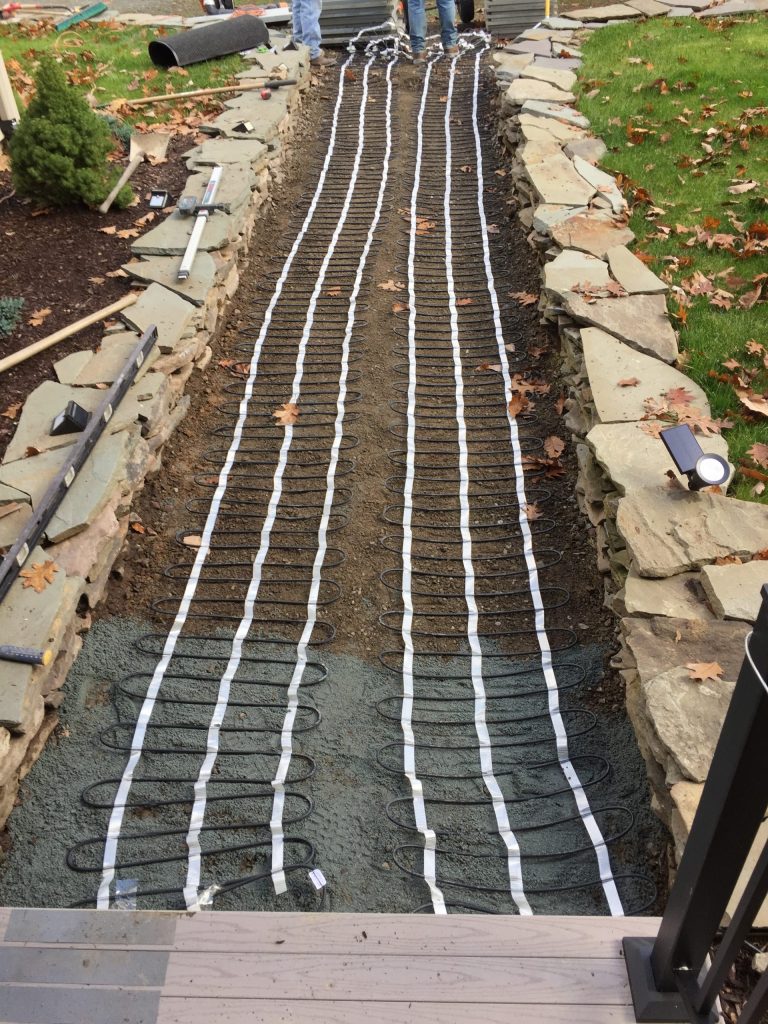
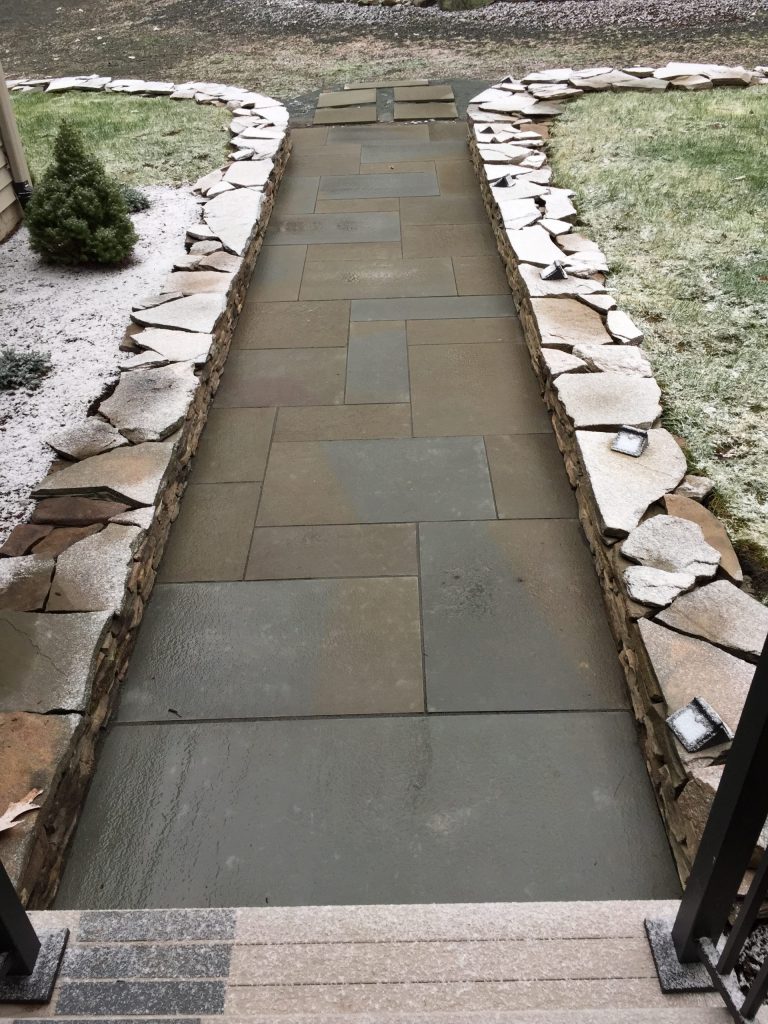
IMG_7215 Installation
IMG_7239-scaled-e1646176800268-768x1024 Installation
IMG_7247-scaled-e1646177005581-768x1024 Installation

The heating cable may be secured in place by landscape stakes and plastic wire ties, welded wire fabric and plastic wire ties or tape. Do not compress or strain the cable. Do not run heavy machinery, equipment, or vehicles over the cable. Be careful to avoid stepping on the cold section factory connection of the cable.

  • Sand Bed Installation: In this installation the aggregate or base is prepared first. Cover the base with 1/2” layer of compact sand. Use welded wire fabric or landscape stakes to place loose heating cables or lay the heating cable mat on the layer of sand in accordance with determined layout. Cover the heating cable or mat with another 1/2” layer of sand. The paver installer must be careful to not walk on the factory connection or damage the heating cable with shovels, rakes or other tools. Cold leads should be sleeved for this installation following conductor fill and size requirements in the NEC and CEC.

Mortar Under Stone & Tile Preparation:

The heating cable may be secured in place with pre-punched steel straps or anchor kits purchased from your Heatizon Distributor or Representative. Do not compress or strain the cable. Do not run heavy machinery, equipment, or vehicles over it. Be careful to avoid stepping on the cold section factory connection of the cable.

  • Mortar Bed Installation: Anchor the heating cable in parallel runs in preparation for mortar placement. Cold leads should also be anchored for this installation back to the exit point of the slab and placed in conduit following conductor fill and size requirements in the NEC and CEC.

Stairs:

IMG_5722 Installation

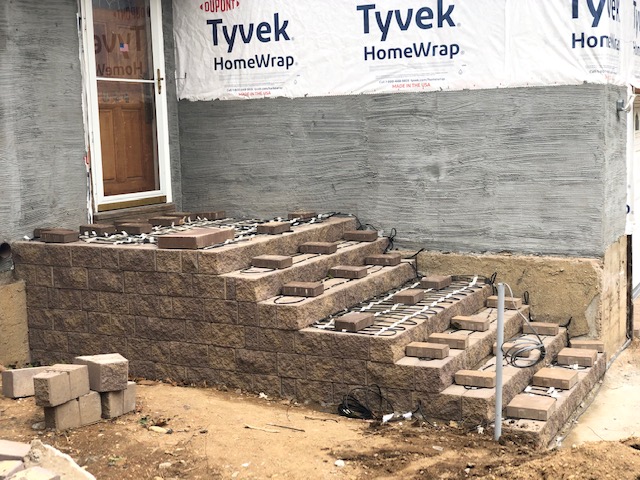
When installing in stairs, ensure that the heating element should not be too close to the edge of the stair and still be completely embedded. Also be sure that where the cable spans the rise of the stairs get embedded in the substrate to avoid causing a hot spot, and damaging the cable. Avoid doing a full run on the rise of the stair.

  • Concrete Stair Installation: The heating element must be 2-3 inches below and spaced 4” away from the edge of the stair. When the cable spans the rise, it too should be completely embedded. If using rebar, use the same methods to secure the cable to the rebar as decribed in the “Concrete” section. Use Jumpers when stairs will have joints between individual stairs, or into adjoining concrete that is to be heated. Be careful to avoid running heating cable where hand rails will be installed.
  • Paver Stair Installation: Be sure that the heating element is properly secured prior to mortaring, and be sure that all the heating element is properly embedded. The cable should not be strained or compressed. Allow the mortar to fully cure before walking on pavers.

Cold Lead(s):

The cold lead(s) should be run in a conduit to either a junction box, panel, or activator and should NEVER cross or come in contact with the SnowMeltz® heating element.


Jump to a section

Area Preparation

Ensure that the substrate has been properly compacted and drainage has been satisfactorily addressed. For substrate preparation and concrete recommendations please refer to page 1 of this manual for “A FEW CONCRETE SUGGESTIONS”. Other site preparation recommendations include, cleaning up the site to eliminate objects that may damage the heating element prior to, during and after the installation.

Use the site sketch to transfer the following information to the site.

  • Identify and mark the location of any and all joints if the heating cable or mat will be installed into a new asphalt or a concrete slab, Do not forget to use jumpers for any and all joints.
  • Determine the location of the starting points of the heating element and the exit points for the cold leads. Connections must be embedded in asphalt, concrete, or other cementitious material.
  • Determine the location of the activation device. If using an in-slab temperature or temperature/moisture sensor, mark the location for the activation device and install a conduit sleeve for the lead wire to the in-slab sensor. An automated activator is the “eyes and ears” of the snow melt system. It is important that it be installed in a location that will allow it to turn the snow melt system “on” when it is needed and “off” when it is not needed. Verify the proper location has been selected for the activation device. Manual activators require human action—as a result they should be placed in a location that is convenient and easily accessible.

Jump to a section

Required Tests

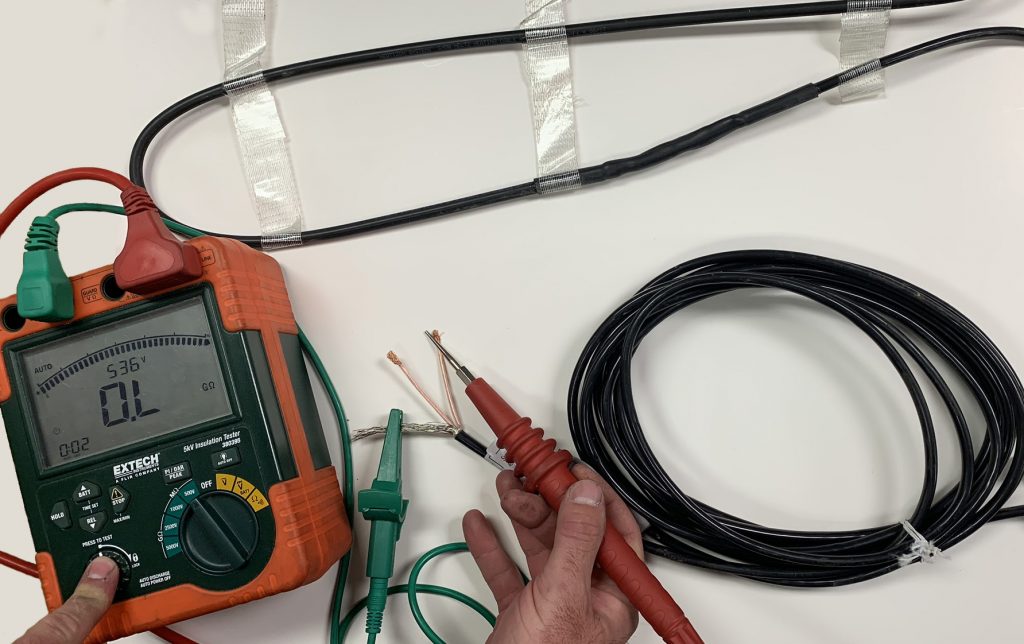
Insulation Resistance with Megohmmeter

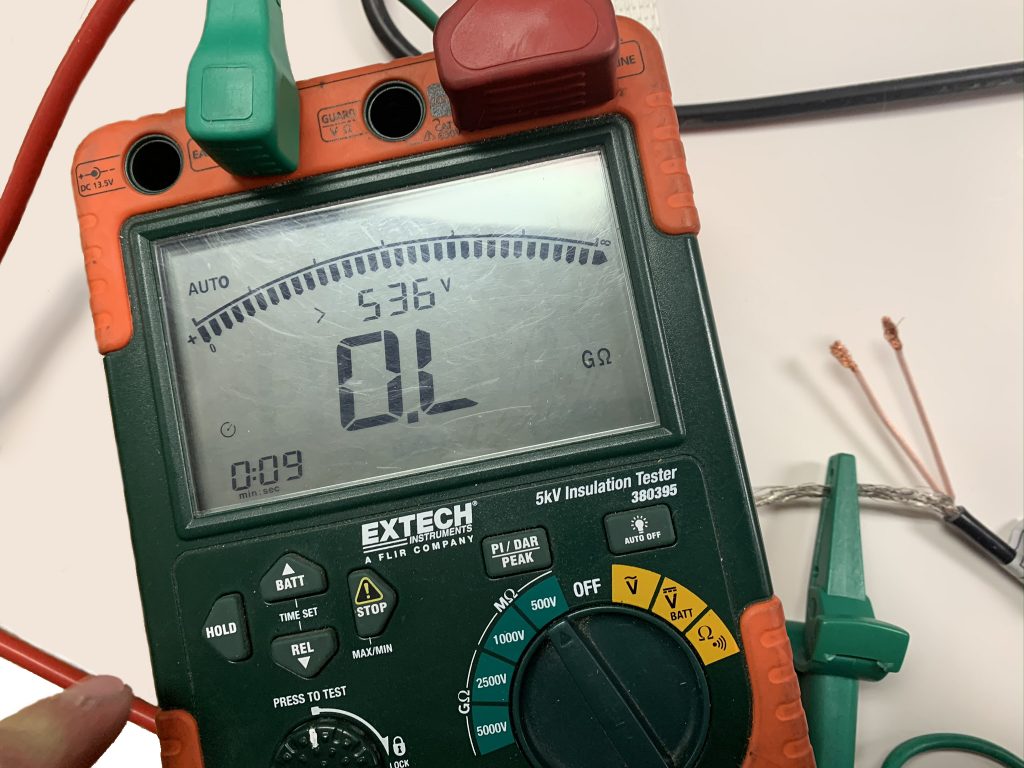
Before, during, and after installation, it is necessary to measure the insulation resistance between the heating conductor and the protective grounding screen with a 500VDC Megohmmeter. This measured value may not be less than 0.5 Megohms. Connect the voltage lead to the inner cold lead conductors and the earth lead to the cold lead outer grounding braid or sheath. Test resistance at 500VDC. Record the measured values in the certificate of warranty.

IMG_1150-1024x768 Required Tests
IMG_1149-1024x644 Required Tests

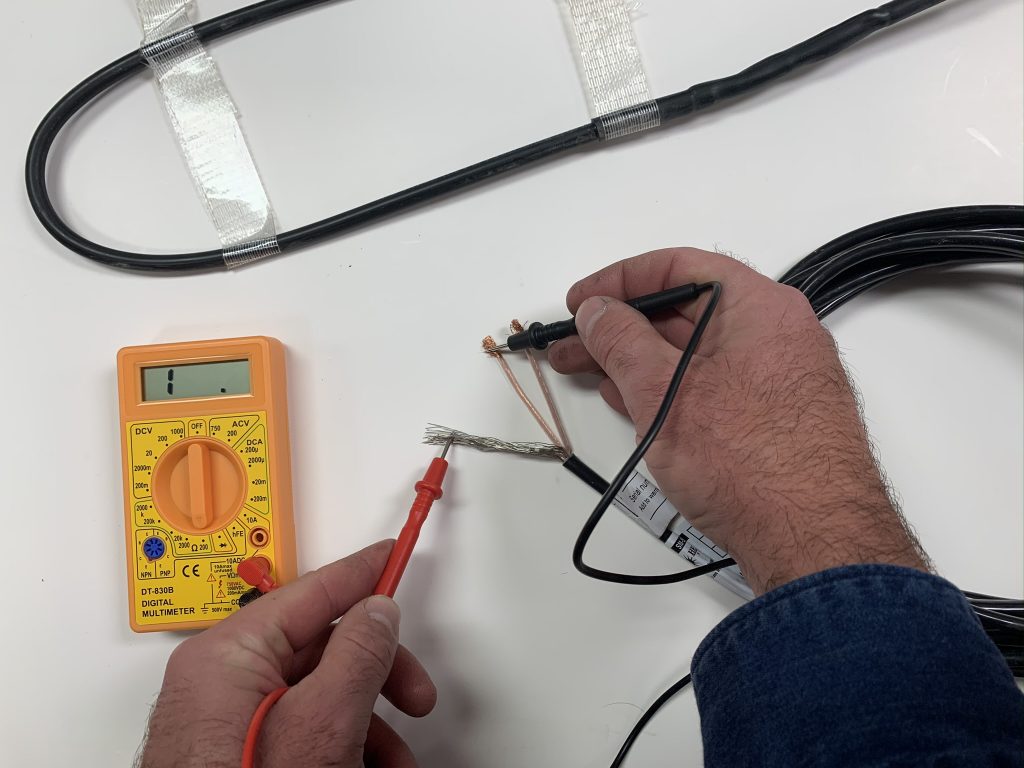
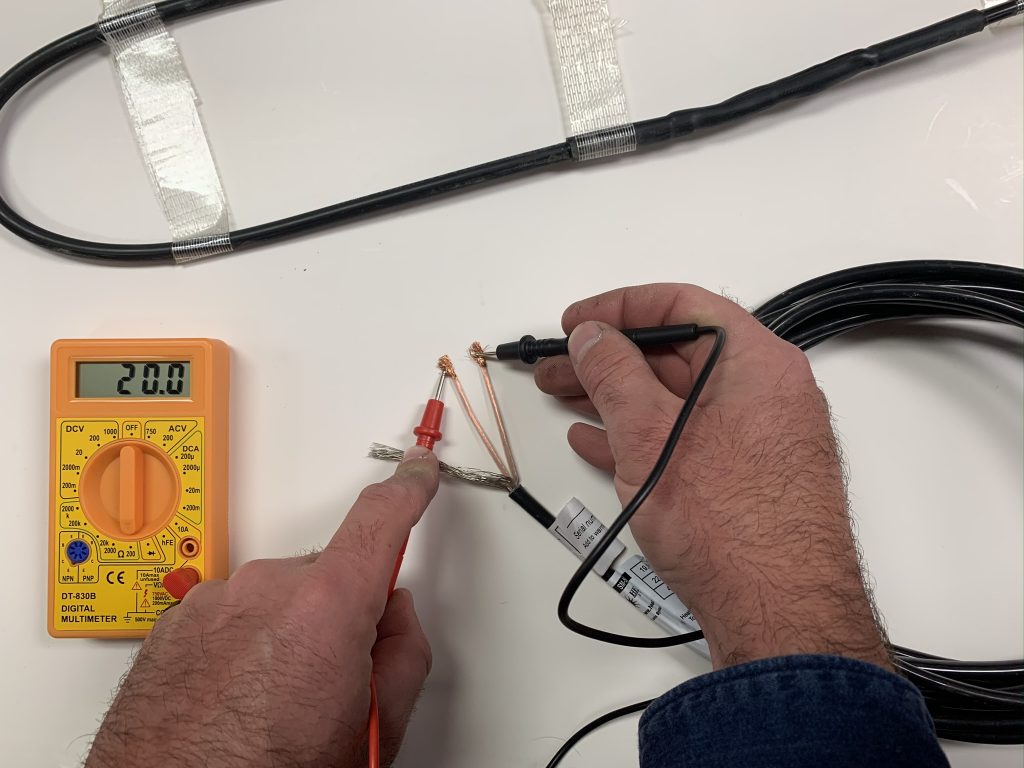
Cable Conductor Resistance with Multimeter

Before, during, and after installation, it is necessary to measure the resistance of the heating circuit with a multimeter. The measured values should be equal -5% to +10%.

Connect one meter lead to the one cold lead inner conductor and the other meter lead to the other cold lead inner conductor. Take the Ohm reading. Record the measured values in the certificate of warranty.

Be sure to check product label for proper resistance, operating amperage, operating voltage, cable length and other important information when performing tests.

IMG_1157-e1646175557883-1024x768 Required Tests
IMG_1156-e1646175546663-1024x768 Required Tests

Jump to a section

SnowMeltz® Installation Design

Gathering Site Information

  • Size and layout of area – Be sure to properly measure the area to be installed to ensure the proper sized SnowMeltz® system has been purchased. Also plan how power will be run to the area and/or met to the cold lead(s).
  • Geographic Location – Depending on the geographic location of the installation area, some adjustments made have to be made during the installation, such as: layout configuration, drainage, heat output, obstacles, etc.
  • Cover or cap material and thickness (1.5” minimum) – SnowMeltz® MUST be embedded in either concrete, asphalt, or sand underneath pavers, ensure the system is at least 1.5 inches from surface.

Determine the Voltage and Amperage

The available supply voltages include 208V, 240V, and 277V.
Ensure based on the voltage and size of system(s) being used,
that there is enough available amperage available.

warning-sign SnowMeltz® Installation Design

Important: Operating SnowMeltz® at voltages they are not designed for will damage the system and void the warranty.

Breaker Size
(Amps)
Max Load
(Amps)
5040
4032
3024
2016
1512

Plan the design*

Determine the optimum SnowMeltz® Mat layout for the heated area to ensure coverage. Determine where the cold lead (20 foot) will join to a junction box, panel, or activation device. When installing multiple systems, be sure to plan layout for multiple cold leads being run to the same location. Use included grid (back of the manual) to layout the SnowMeltz® system(s).

Snowmeltz-layout-1024x618 SnowMeltz® Installation Design
  • Make certain to plan for the movement of water created by melted snow.
  • The transition joint between the heating element and the cold lead must be embedded in asphalt, concrete, sand, stone dust, or cementitious material. Do not bend the heating cable within 3” of cold connection.
  • Activation Devices are the eyes and ears of the heating system. Location is important. Please reference installation and operation information in the activation device product literature. Some activation devices may or may not require a different voltage than the heating cable.
  • Consult Heatizon Systems for any other questions.
Snowmeltz-layout-panel-1024x541 SnowMeltz® Installation Design
More than 30 amp SnowMeltz load
Snowmeltz-layout-NO-panel-1024x541 SnowMeltz® Installation Design
Less than 30-amp SnowMeltz load

Jumpers

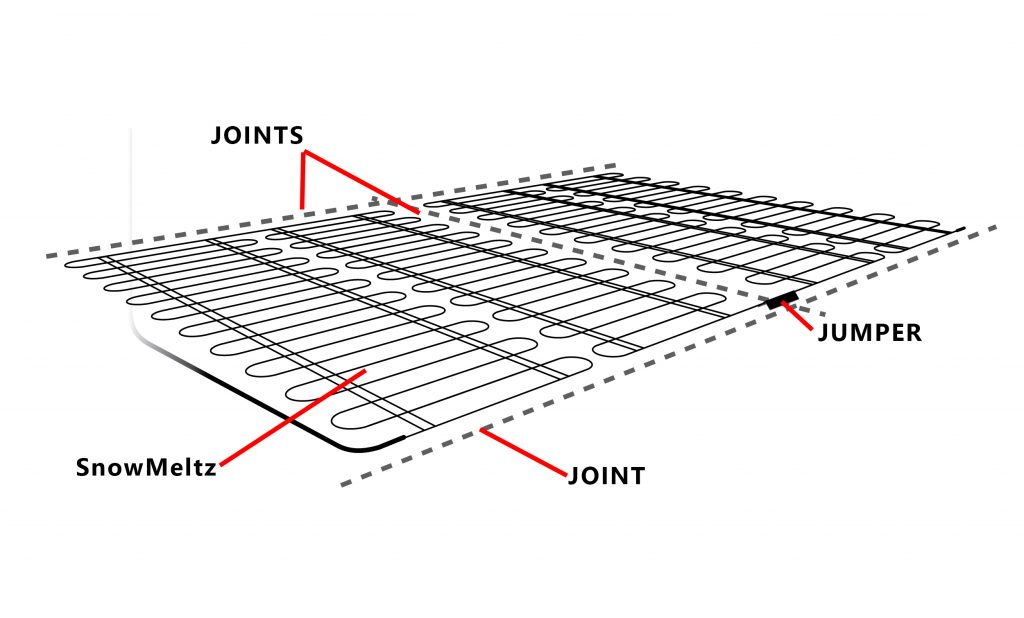
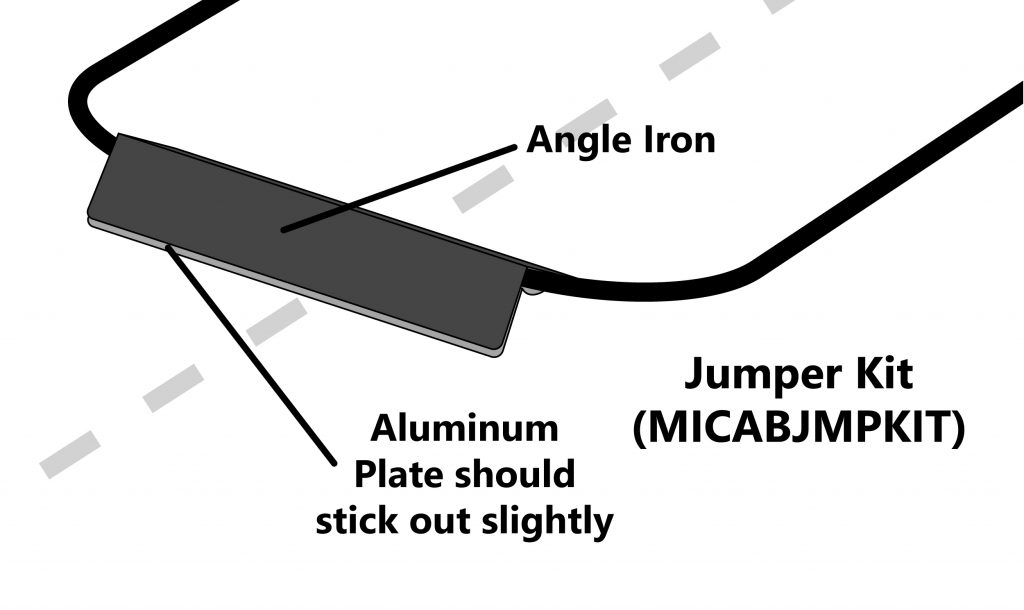
ASHRAE, NEC, and Heatizon always require the use of jumpers through joints. Never extend the heating cable through any joint in asphalt and/or concrete without a jumper. Determine the number of joints in order to determine the number of Jumper Kits required for the project. Always jumper joints using the appropriate jumper kit provided by Heatizon Systems.

When laying out SnowMeltz® in concrete where jumpers will need to be used, best practice is to minimize the number of times the heating element will cross joints. Ideally, arrange the layout so that the mat fills one section of the concrete (between joints) then crosses the joint(s). The best solution for jumpers is to use the jumper Kit supplied by Heatizon (Heatizon Part #MICABJMPKIT), it includes components for four jumpers.

Snowmeltz-jumpers-1-1024x618 SnowMeltz® Installation Design

CONCRETE JOINTS AND USING JUMPERS

jumpers-diagram-1024x610 SnowMeltz® Installation Design

Control Joints: Control Joints are intended to control where the slab will crack and are placed either in fresh concrete or saw cut in after the concrete is poured. Spacing of these joints will vary depending on the size and shape of the slab. Use the Cable Jumper to protect the heating cable when crossing control
joints.

Construction Joints: Construction joints are a common result when multiple concrete pours are completed at different stages during construction. Use a Cable Jumper to protect the heating cable when crossing construction joints.

Expansion Joints: Expansion or Isolation joints result when concrete is isolated from something else which can be concrete, a wall, column etc. When an expansion joint is used between two concrete slabs the two structures are not connected using rebar, therefore movement can/will occur between them. Do not cross expansion joints with the heating portion of the cable. The cold lead portion of the cable may cross expansion joints as long as the cold lead is buried under or sleeved with conduit at the bottom of the joint.


Jump to a section

Product Selection

Since SnowMeltz CANNOT be shortened, it is vital to choose the correct size system before installing. It is advisable to always get a smaller system for the area, for example: if the area is 48 square feet, choose a 40 or 45 square foot system.

SnowMeltz® Mat, 50 Watts/Ft2 @ 208 VAC

Heatizon Part
Number
Total
Watts
Total
Ohms
Amps
@ 208V
Coverage
Area/Square
Foot
Watts per
Foot
Watts/
Square
Foot
Mat
Length
Mat
Width
Cold Lead
Length/
AWG
SM-50W208-10520120.02.41012505′24″20’/14
SM-50W208-1582580.03.61512507.5′24″20’/14
SM-50W208-25123560.0625125012.5′24″20’/14
SM-50W208-35174548.08.435125017.5′24″20’/14
SM-50W208-45224540.010.845125022.5′24″20’/14
SM-50W208-60299534.314.460125030′24″20’/14
SM-50W208-75368011.81875125037.5′24″20’/14
SM-50W208-10047409.124100125050′24″20’/14

SnowMeltz® Mat Models – 50 Watts/Ft2 @ 240VAC or 37 Watts/Ft2 @208VAC

Heatizon Part NumberTotal
Watts
Total
Ohms
Amps
@ 240V
Watts/
Sqft
240V
Watts/FtAmps @
208V
Watts/
Sqft 208V
Coverage
Area/Square
Foot
Mat
Length
Mat
Width
Cold Lead
Length/
AWG
SM-50W240-37W208-15775120.03.250122.837158′24″20’/14
SM-50W240-37W208-2095080.04.050123.4372010′24″20’/14
SM-50W240-37W208-30142560.05.950125.1373015′24″20’/14
SM-50W240-37W208-35184048.07.750126.6373518′24″20’/14
SM-50W240-37W208-45221540.09.250128.0374522′24″20’/14
SM-50W240-37W208-60301534.312.6501210.9376030′24″20’/14
SM-50W240-37W208-75366030.015.3501213.2377537′24″20’/14
SM-50W240-37W208-11055009.122.9501219.93711055′24″20’/14

SnowMeltz® Mat Models – 50 Watts/Ft2 @ 277VAC or 37 Watts/Ft2 @240VAC

Heatizon Part NumberTotal
Watts
Total
Ohms
Amps
@ 277V
Watts/
Sqft
240V
Watts/FtAmps @
240V
Watts/
Sqft 240V
Coverage
Area/Square
Foot
Mat
Length
Mat
Width
Cold Lead
Length/
AWG
SM-50W277-37W240-10426180.11.55012137104′24″20’/14
SM-50W277-37W240-15712107.82.65012237157′24″20’/14
SM-50W277-37W240-20110069.84.050123372010′24″20’/14
SM-50W277-37W240-25125061.44.550124372513′24″20’/14
SM-50W277-37W240-35165046.56.05012537351724″20’/14
SM-50W277-37W240-40205037.47.450126374021′24″20’/14
SM-50W277-37W240-45225034.18.150127374523′24″20’/14
SM-50W277-37W240-50250030.79.050128375025′24″20’/14
SM-50W277-37W240-60299525.610.850129376030′24″20’/14
SM-50W277-37W240-75361021.313.0501211377537′24″20’/14
SM-50W277-37W240-85421018.215.2501213378543′24″20’/14
SM-50W277-37W240-100490015.717.75012153710050′24″20’/14
SM-50W277-37W240-130635012.122.95012203713065′24″20’/14

Jump to a section

SnowMeltz® System

SnowMeltz® Specifications & Electrical Connections

Cable ConstructionTwin Conductor
Rated Voltage120VAC to 600VAC
Output12 watts/ft max.
LengthRefer to Individual Product Labels
Cable Diameter0.24” to 0.35”
Cable TypeConstant Wattage
Conductor InsulationFluoropolymer
Outer InsulationCross-Linked XLPE
Protective ScreenTinned Copper
Outer JacketCross-Linked Halogen Free Fire Retardant
Polyolefin with UV Protection
Heating Endurance-22°F(-30°C) to 194°F(90C)
Short Term Heating
Endurance for Asphalt
464°F(240°C) not to exceed 30 minutes
Minimum Spacing2”
Standard Spacing3” to 6”
Cap Thickness2” to 4” max
Bending Radius6D** (approx. 2”)
Thermal Resistance464°F(240°C) – Do not to exceed 30 minutes

120V and 277V
Connection

PHASECopper Element
(Cold Lead)
NEUTRALCopper Element
(Cold Lead)
GROUNDShield Braid
(Cold Lead)

208V, 240V and 480V Connection

PHASECopper Element
(Cold Lead)
PHASECopper Element
(Cold Lead)
GROUNDShield Braid
(Cold Lead)
snowmeltz-label SnowMeltz® System

SnowMeltz® Labels on mat include the following information:

  • Listing information
  • Serial number
  • Size of mat
  • Allowable voltages for product
  • Amps at selected voltage
  • Ohms of cable
  • Total Watts generated
  • Number of conductors
  • Watts per foot (at voltage)

It is important that heating cable be installed only by qualified persons who are familiar with the proper sizing, installation, construction and operation of snow melting systems and the hazards involved. Heating cable products are designed for in and under concrete, asphalt, and paver snow melt applications.

  • Article 426 of the NEC requires ground fault protection for line voltage equipment embedded in a noncombustible medium. Check local building codes and regulations for ground fault protection device (i.e. GFCI, GFEP, etc. ) requirements when installing all heating cable products.
  • Do not bend heating cable within 3” of a termination or connection between the heating element and the cold lead. Heating cables cannot cross or touch one another.
  • Article 426 of the NEC limits embedded deicing and snow melting equipment to a maximum of 1300 watts/m² (120 watts/ft²) of heated area.
  • Store the heating cable in a dry place up to the resistance temperature of the jacket 194°F (90°C).
  • Minimum installation temperature is 23°F (-5°C)
  • Read the instructions carefully before installing SnowMeltz® system.
  • Remember to measure the resistance four times.
  • The heating cable cannot be cut to length, crossed over itself, or installed too close to itself.
  • Remember to check that the supply voltage matches the voltage of the SnowMeltz® system.
  • Remember to place the labels as written in this instruction.
  • Only for outdoor installation, not for roofs.

Please consult Heatizon Systems for any other questions.


Jump to a section

Important Safeguards and Warnings

WARNING: Shock and fire hazard

  • If the SnowMeltz® System is damaged or not installed properly, fire or shock could occur resulting in serious personal injuries or damage to property. Carefully follow the warnings and instructions contained in this manual.
  • It is important that this equipment is installed only by qualified persons who are familiar with the proper sizing, installation, construction and operation of floor warming systems and the hazards involved.
  • The installation must comply with all national and local electrical codes. Consult the authority in the jurisdiction familiar with these requirements, the NEC (National Electric Code), or CSA (Canadian Standard Association) should there be any questions.
  • The SnowMeltz® System is designed for Concrete, Asphalt, and Sand (paver) exterior heating purposes only. Be sure that the surface will be completed in such a way to not cause mechanical damage to this system in the future.
  • If the SnowMeltz® System is damaged, it must be replaced or repaired. To repair or to splice any part of the system, use only Heatizon SnowMeltz® Repair Kit (part number SMRPKIT).

General Guidelines

Use of the Manual

This manual describes the SnowMeltz® heating system — how to design the space, select
the product, and install the system. It is important to thoroughly review this manual and the
Activator Installation and Operation Manual prior to installation.

Heatizon Systems
4137 South 500 West
Murray, UT 84123 USA
Tel: 888-239-1232
Tel: 801-293-1232
Fax: 801-293-3077

DOWNLOAD THE STANDARD SNOWMELTZ MANUAL
(PDF VERSION)

DOWNLOAD THE EXPANDED SNOWMELTZ MANUAL
(PDF VERSION)

Safety Guidelines

The safety and reliability of any snow melting system depends on proper design, installation, and testing. Incorrect installation or mishandling of the product can cause damage to the heating cable, system components and property, and can create a risk of fire or shock. The guidelines and instructions contained in this manual are important. Follow them carefully to minimize these risks and to ensure that the SnowMeltz® System performs as designed.

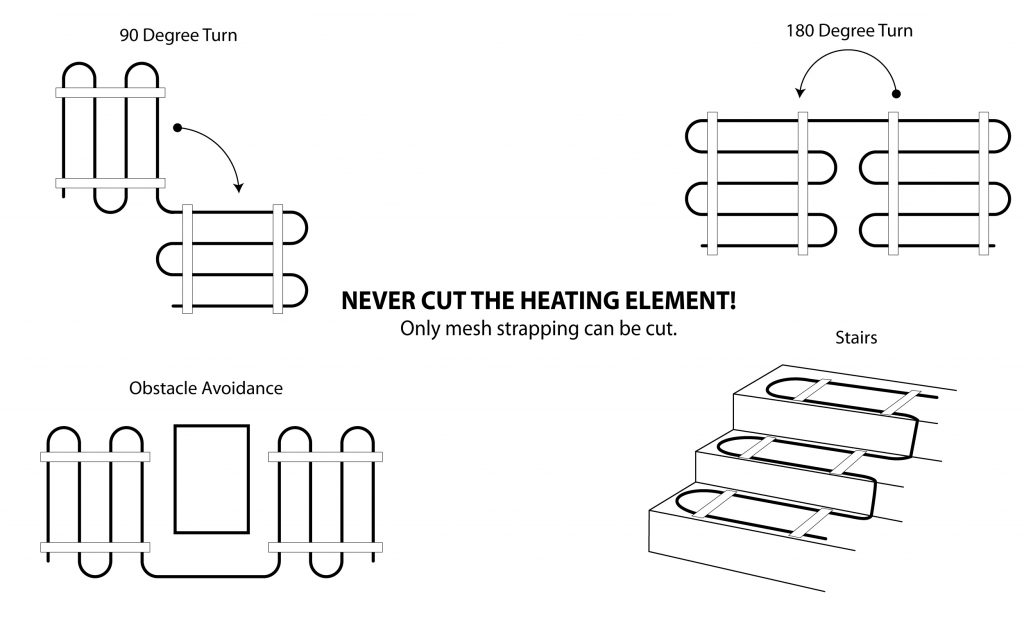
The SnowMeltz systems are engineered to achieve specific heat output for the square footage to which they are designed. Cutting the heating cable to fit a space is extremely dangerous and can result in a fire. Do not cut the heating cable to avoid an obstacle or fixture, use other methods as described in this manual. Make sure to avoid damaging/cutting the heating cable during/after the installation of the substrate by being aware of all heating cable locations.


Jump to a section

Concrete Suggestions

Heatizon Systems is not an asphalt, concrete or pavers expert, but we have a few suggestions that you may wish to discuss with your contractor. We make these suggestions in an effort to increase the likelihood that Heatizon Systems’ SnowMeltz® will be surrounded by products that are equal to it in both quality and expected longevity. In addition, we make these suggestions in an effort to reduce the possibility that your SnowMeltz® heating element will get damaged or broken by the vertical or horizontal movement of asphalt, concrete, or pavers.

Dry Base: Make certain that the ground below where the new asphalt, concrete or pavers will be located is as dry as possible. It is recommended that it be covered whenever there is a risk of a storm for one to two weeks prior to the pour.

Excavation: Be sure that your excavation is deep enough to accommodate the thickness of the concrete, the thickness of the insulation, the depth of the aggregate base you will have below the concrete and a 1” sand bed if you elect to install the SnowMeltz® below the concrete.

Compaction: Once the excavation is complete, it is highly recommended that a great deal of care be given to completely and properly compact the entire area where the asphalt, concrete or pavers will be located.

Drainage: In order to have proper drainage and to reduce the likelihood of vertical shifting of your asphalt, concrete, or pavers Heatizon Systems recommends that a minimum of 6 inches of high quality aggregate be laid over the entire area where the asphalt, concrete, or pavers are to be installed, plus one foot around all edges.

Reinforcement: In order to enhance the integrity of your asphalt, concrete or pavers, Heatizon Systems recommends that reinforcement be considered. Most of the time concrete can be reinforced with number 4 gauge welded wire fabric or ½ inch re-bar placed at least 2 inches from the top and bottom surfaces of the concrete.

Insulation: Insulation is a two edged sword. On the one hand, it acts as a good moisture barrier, reduces the response time of your snow melt or heating system, and saves money by reducing operating time. On the other hand, insulation does not allow the heat from the ground to get into the asphalt, concrete, or pavers.

Maximum Area: Heatizon Systems recommends that concrete be poured in square sections no larger than 9.5 feet X 9.5 feet. Pouring other geometric shapes without additional joints almost always results in cracking. Each square must always have a joint on each of its four sides.

Thickness: Heatizon Systems always recommends the following thickness be observed:

  • Concrete 5 or more inches
  • Asphalt 4 or more inches
  • Pavers 4 or less inches

Suggested Mix: Heatizon Systems recommends that a six-bag mix with fiber or steel fibers always be used when pouring concrete.


Jump to a section

Introduction

Heatizon Systems is glad to offer product phone support for the SnowMeltz® product. It is VERY important to have read this manual first. Please have your resistance test numbers and system model name/number available BEFORE calling for technical support.

The SnowMeltz® Heating Cable comes in pre-established lengths that have been designed to deliver a specified heat density. Therefore, it is essential that all of the SnowMeltz® Heating Element contained in the kit be installed. Do not cut or alter the heating cable in any way.

In order to minimize the risk of damage to the SnowMeltz® Heating Cable, Heatizon Systems recommends that the SnowMeltz® Cable be installed immediately prior to the installation of the cementitious material that goes over it.

Never cross the SnowMeltz® Heating Cable over itself or any other conductor or wire.

When installing Heatizon Systems products, strict compliance with the National Electrical Code, local Building Codes, and Heatizon’s Installation Manual is essential.

It is highly recommend to take photographs to document the installed SnowMeltz® for future
reference before completing installation.


Jump to a section